
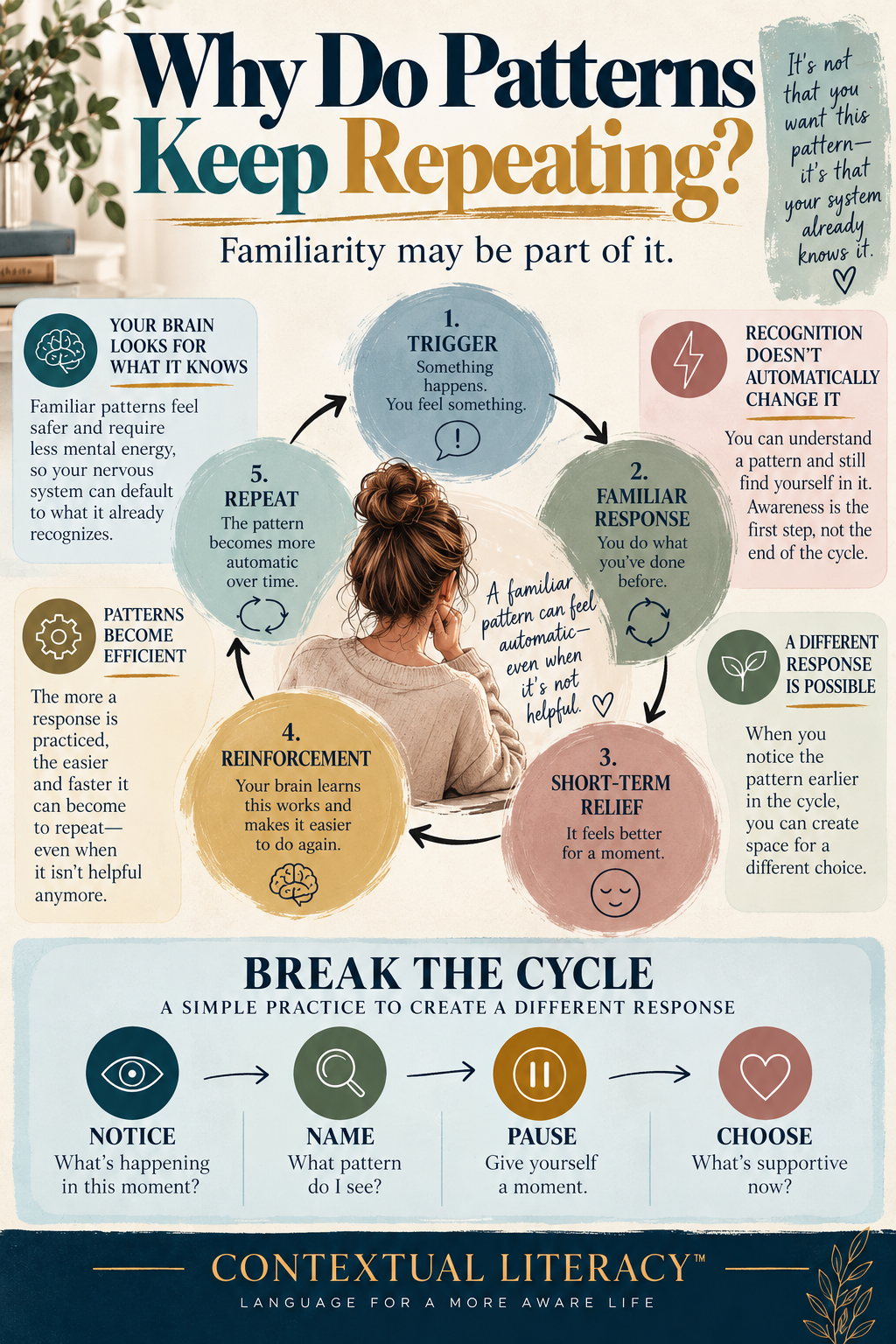
Patterns Repeat Because They’re Familiar: Understanding Automatic Responses
Why do we repeat patterns even after we recognize them? Familiar responses can become automatic through repetition and experience. Understanding how the pattern developed can create space for curiosity, context, and a different response.
Have you ever recognized a pattern while you were doing it and thought, I know exactly what I’m doing. But why am I doing it again?
You know you don’t need to explain yourself to this person for another ten minutes, but you keep explaining. You recognize that you’re taking responsibility for someone else’s reaction, but your mind is already trying to figure out how to make things better. You told yourself you were going to pause before answering their next request, and somehow “Sure, I can do that” is already out of your mouth.
Recognizing a pattern and immediately changing a pattern are two very different things.
That can be frustrating, especially when you’ve already spent time becoming more aware of yourself. We tend to assume that once we understand something, we should simply stop doing it. When the behavior shows up again, it can feel like evidence that nothing has changed.
But there may be something much simpler happening.
Familiar Responses Require Less Work
A pattern becomes a pattern because it has been repeated.
The more often we respond to a particular situation in a particular way, the more familiar that response becomes. We don’t have to consciously work through every step anymore because we already know the route.
Think about driving somewhere you’ve been hundreds of times. You probably don’t consciously consider every turn. Compare that with driving somewhere completely new, where you’re watching street signs, checking directions, and paying much more attention to what comes next.
Emotional and behavioral patterns can develop their own familiar routes too.
Someone becomes disappointed —you explain more.
Someone needs something—you accommodate with an agreement or the answer they are looking for.
Conflict appears—you withdraw.
You feel uncertain—you look for reassurance.
The response can begin before you’ve consciously decided whether it is what you want to do.
Familiar Doesn’t Mean Intentional
This is an important distinction because we can easily assign meaning to an automatic response after it happens.
“I must have really wanted to say yes.”
“I guess I’m just someone who avoids conflict.”
“I knew I shouldn’t have said that. Why do I always do this?”
Instead of immediately turning the response into a statement about who you are, it can be useful to become curious about the pattern itself.
What happened right before the response?
What did I recognize in that situation?
What did I expect would happen next?
What response have I practiced here before?
Those questions give us context. They allow us to examine the route instead of simply criticizing ourselves for taking it again.
The Pattern May Have Worked
There is another piece worth considering: many of our repeated patterns were useful somewhere.
Explaining may have reduced conflict. Being agreeable may have created connection. Anticipating someone’s needs may have helped you navigate an unpredictable environment. Avoiding a difficult conversation may have felt like the safest available choice at another point in your life.
And you’ve realize that this pattern isn’t useful in every situation. You now may want it to stop. You’ve tried willpower. But there is more to it than willpower alone.
Context changes the conversation from “Why am I doing this again?” to “I recognize why this response became familiar. But the new questions is: does it fit what is happening now?”
That is a very different question.
How a Pattern Reinforces Itself
A familiar response can create a fairly simple cycle:
Trigger → Familiar Response → Short-Term Relief → Reinforcement → Repeat
Imagine someone asks you to do something you don’t really have time to do. You feel the pressure of the request and automatically say yes. The immediate discomfort disappears because you don’t have to risk disappointing the person.
For the moment, saying yes worked.
The scheduling problem comes later.
That short-term relief can reinforce the response, even when the longer-term result creates stress, resentment, exhaustion, or another problem you didn’t want.
This is one reason it can be useful to look beyond whether a response made the immediate moment easier and ask what happened afterward.
Interrupting the Cycle
Changing a familiar pattern doesn’t necessarily require a dramatic intervention. Often, the first change is simply recognizing the pattern a little earlier than you did before.
That might look like:
Notice what is happening before you automatically respond.
Name the familiar pattern without turning it into a judgment about yourself.
Pause long enough to gather more information.
Choose what fits the situation you are actually in.
At first, you may notice the pattern after it happens. Later, you might recognize it while it is happening. Eventually, there may be moments when you notice it before the familiar response has completely taken over. —Those are all meaningful changes.
The old pattern appearing does not necessarily mean you are back where you started. The important question is whether the pattern still gets to make every decision.
Familiarity Is Information
One of the goals of Contextual Literacy™ is to become more accurate about what our reactions are telling us.
A familiar response gives us information. It can show us what we have practiced, what we have learned to expect, what has worked before, and where we may be responding to the present through the context of an earlier experience.
We don’t have to shame the pattern, and we don’t have to obey it.
We can recognize it.
I know this pattern. I understand why this route is familiar. But I don’t have to follow it simply because I know the way.
A Simple Completion
If you recognize a pattern that keeps repeating, try this:
I acknowledge the responses and behaviors that became familiar through repetition and experience. I release the expectation that recognizing a pattern means I should immediately know how to change it. I give myself permission to notice the pattern, become curious about its context, and create space for a response that fits what is happening now.
What becomes possible when recognizing a familiar pattern gives me information without requiring me to repeat it?
You don’t have to erase the old route before you can begin choosing another one. Each time you recognize the pattern with more awareness and more context, you create another opportunity to decide what happens next.
Contextual Literacy™ puts language around the patterns shaping how we think, feel, and respond.
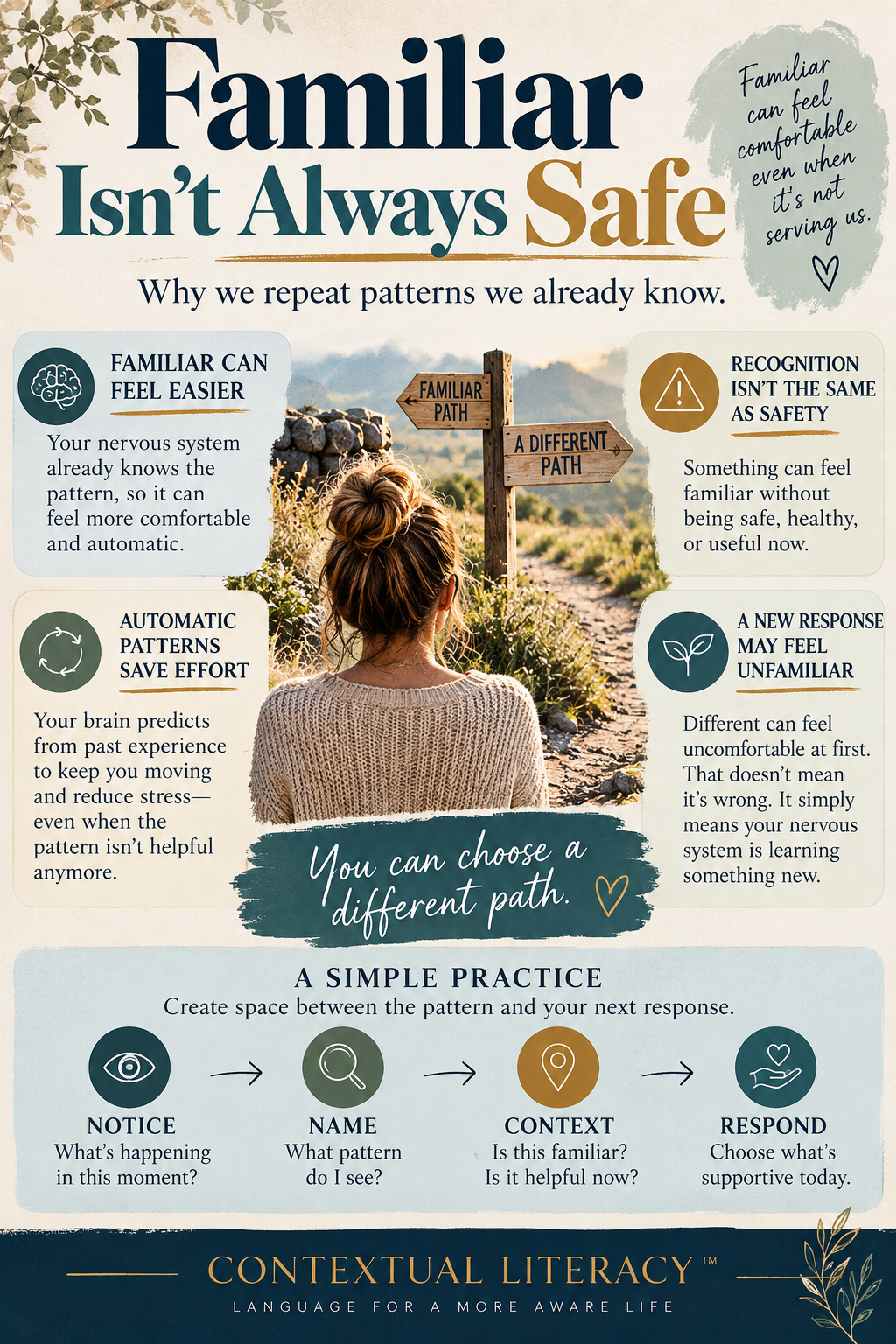
Familiar Isn’t Always Safe: Why Familiar Patterns Can Be So Powerful
Familiar patterns can feel comfortable simply because we recognize them—even when they’re no longer useful. Explore why familiar responses can become automatic and how noticing the pattern can create space for something different.
Have you ever known that a pattern wasn’t working for you—and still found yourself doing it?
You recognize the relationship dynamic.
You recognize the reaction.
You recognize the habit.
You may even be able to explain exactly where it came from.
And yet, when something happens, there you are again.
This is where an important distinction becomes useful:
Familiar isn’t always the same thing as safe.
And familiar isn’t necessarily the same thing as good, healthy, or useful.
Familiarity gives the brain information
—Our brains continuously use previous experience to interpret what is happening now. That’s useful.
We don’t want to approach every ordinary experience as though we’ve never encountered anything like it before.
Previous experience allows us to recognize patterns, make predictions, and respond efficiently.
But efficiency has a complication:
A familiar response can become easier to repeat simply because it has been practiced.
That doesn’t mean your nervous system has thoughtfully determined that the response is the best possible choice.
It does means your system already knows the route.
Familiar can feel comfortable even when it isn’t serving us
This is one reason why change can feel so strange. We often assume that if a new behavior is healthier, it should immediately feel better.
But imagine you’ve spent years explaining yourself whenever someone is disappointed with you.
Then one day you give a clear answer and stop explaining.
That may be appropriate.
It may also feel incredibly uncomfortable.
The discomfort doesn’t automatically mean you’ve made the wrong choice.
You have interrupted something familiar.
Recognizing this information is not the same as safety—This distinction matters.
What you may recognize is a familiar:
Relationship dynamic
Emotional reaction
Overworking
Avoidance
Taking responsibility for everyone
Immediately saying yes
Your system “recognizing the pattern” it doesn’t take into account if it still fits your current life.
That’s where the complete context becomes important.
When you notice that familiar pull, try walking through four questions:
NOTICE —What is happening in this moment?
NAME—What familiar pattern do I recognize?
CONTEXT—Is this actually the same situation? Is this response useful here?
RESPOND—What response fits what is happening now?
Just take note:
You don’t have to erase the old pattern before making a different choice.
You may still feel the familiar urge.
You may still notice the old response beginning to organize.
The difference is that familiarity no longer has to make the entire decision.
-Sometimes change begins when we recognize: “I know this pattern. But I don’t have to follow it simply because I know the way.”
A Simple Completion
I acknowledge the patterns and responses that became familiar because they once served a purpose. I release the belief that familiarity alone means a response is right, necessary, or useful for me now. I give myself permission to notice what is happening in the present before automatically following what I have done before.
What becomes available to me when familiar no longer has to determine what comes next?
Contextual Literacy™ puts language around the patterns shaping how we think, feel, and respond.
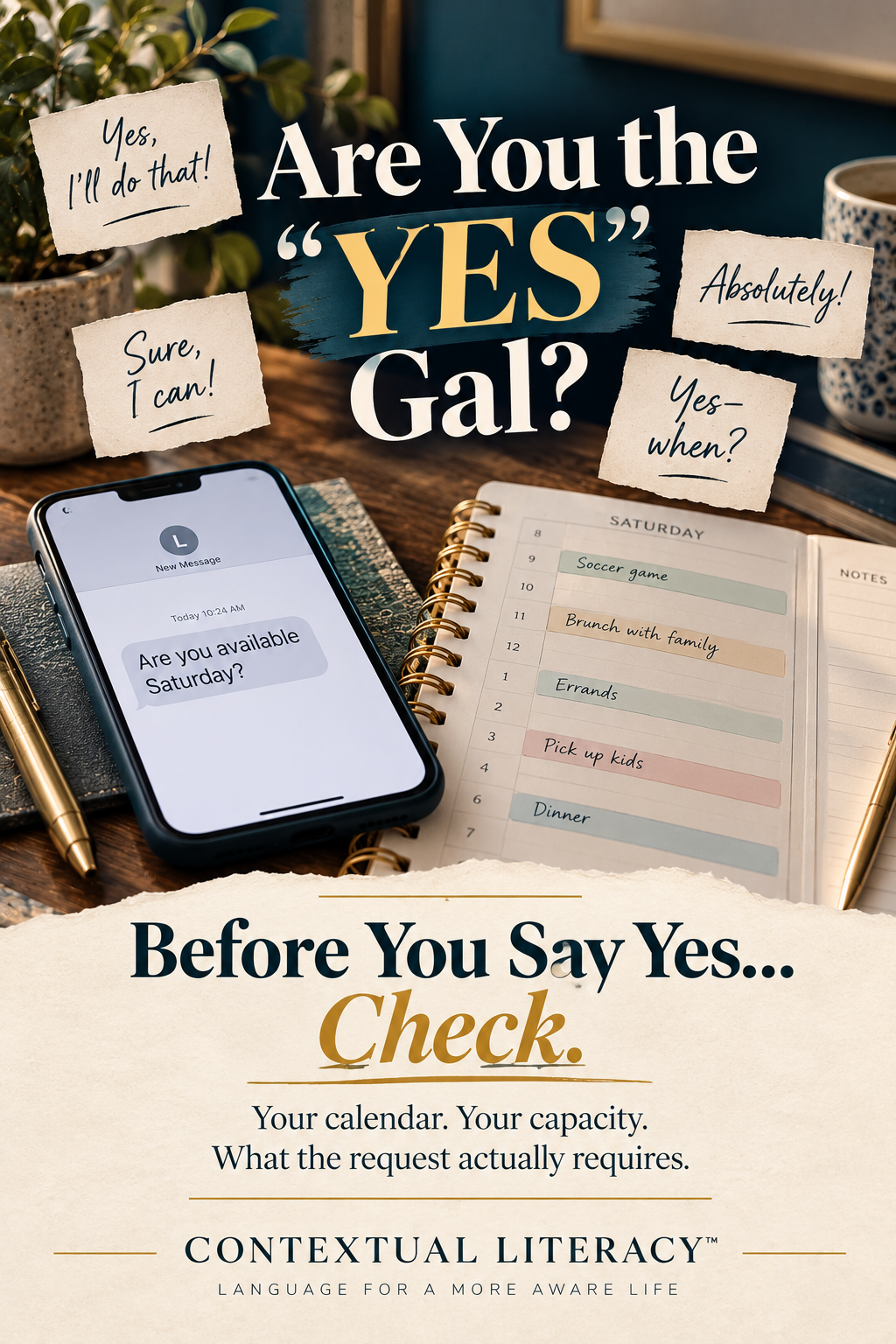
Are You the “Yes” Gal? Before You Say Yes, Check
Are you the person who says yes before you’ve even checked? A simple pause can give you space to consider your capacity commitments, and what you genuinely want to—so your yes comes from choice rather than expectation.
“Yes, I’ll do that!”
“Sure, I can!”
“Absolutely!”
“Yes—when?”
And only afterward: Wait. What did I just agree to?
If you recognize yourself here, you may be what I affectionately call the “yes gal.”
The yes isn’t necessarily coming from poor judgment. Often, it’s coming from something quite lovely.
You want to accommodate people.
You want to be dependable.
You care about their needs.
You don’t want to make things difficult.
The problem isn’t generosity.
The problem is answering before you have checked whether your yes actually fits.
Your yes affects more than the person asking
Imagine someone asks whether you’re available Saturday.
If you answer immediately, you are responding to one piece of information:
They need something Saturday.
But there may be considerably more context.
What’s already on your calendar?
What does the rest of the week look like?
Will saying yes require someone else in your household to change their plans?
Do you actually have the energy or time?
What exactly are you agreeing to?
Those aren’t excuses.
They’re information.
Accommodation can become automatic
If meeting other people’s needs feels particularly important to you, their request may become emotionally louder than everything else.
That’s when checking can feel strangely uncomfortable.
You already know they want an answer and you know what would make them happy. And you may feel responsible for accommodating them. But respecting another person’s request doesn’t require ignoring yourself—or the other people affected by your decision.
Before you say yes, check
Try making CHECK part of the pattern.
Check your calendar.
Check your capacity.
Check existing commitments.
Check what the request actually involves.
Check with other people whose plans would be affected.
Then answer.
This isn’t about becoming less generous.
It’s about making generosity sustainable.
A yes given with accurate information is very different from a yes followed by resentment, exhaustion, rearranging, or trying to figure out how you’re going to make everything work.
So the next time you hear yourself preparing to say:
Sure!
Try:
“Let me check.”
You can still say yes.
You are now just simply giving yourself enough information to know whether you mean it. You will be surprised how you different it feels to say yes from a place of truly wanting to do —or from recognizing a need you genuinely want to meet —rather than saying yes out of expectation.
A Simple Completion
Read aloud statement
I release the expectation that I need to say yes in order to be accommodating, supportive, or kind. I give myself permission to check my capacity, my commitments, and what I genuinely want before I answer.
What becomes possible when my yes comes from choice rather than expectation?
Contextual Literacy™ puts language around the patterns shaping how we think, feel, and respond.
⸻
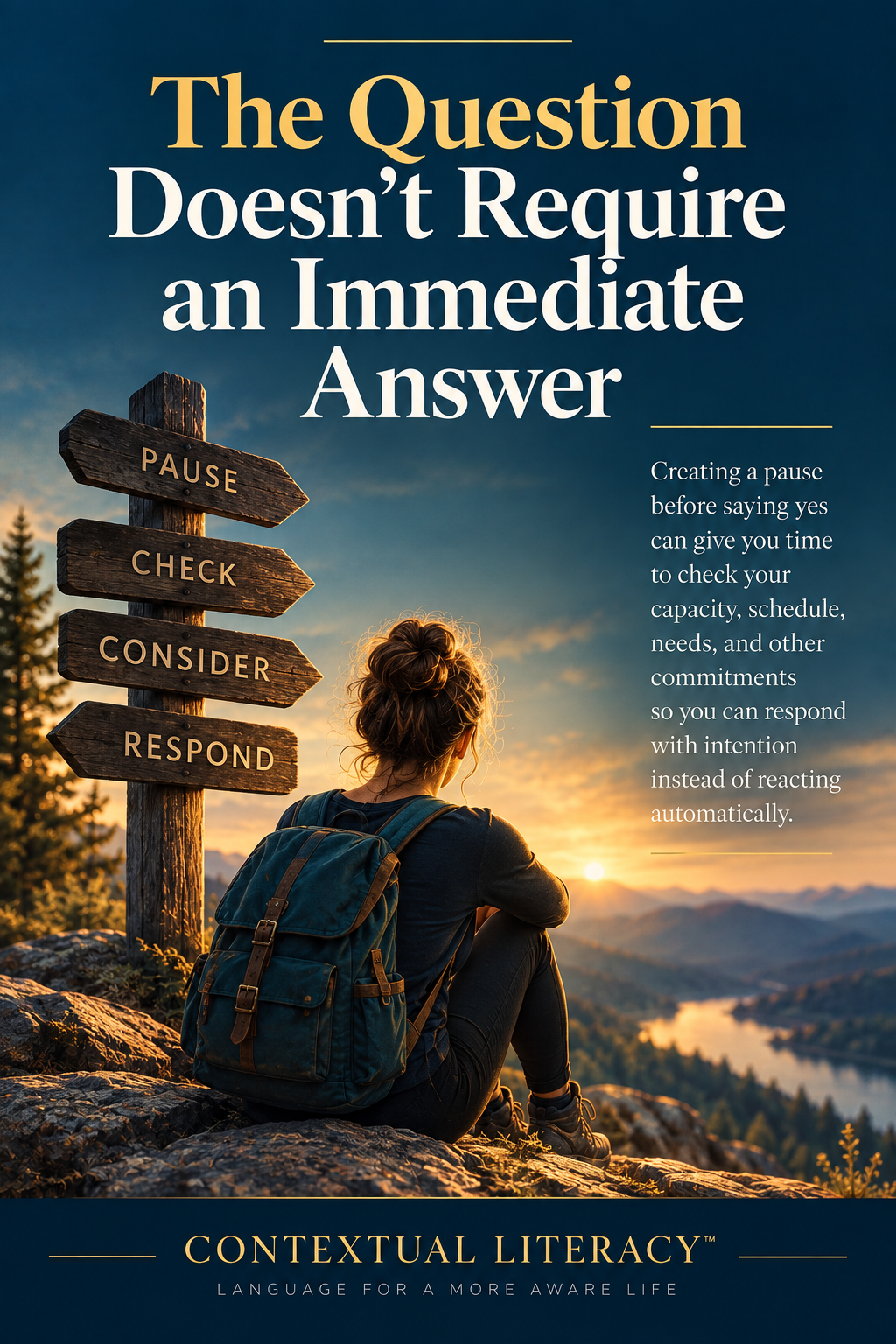
The Question Doesn’t Require an Immediate Answer: Creating Space Before You Say Yes
A question doesn’t automatically require an immediate answer. Sometimes the pause isn’t about indecision-it gives you time to check your schedule, capacity, commitments, and the information you need before responding.
This is for those who always seem to respond “yes” to questions. Quick with your yes, while honestly either not wanting to do it, have plans or it’s going to cause major inconvenience.
Someone asks:
“Can you do this?” —And almost immediately you respond with Sure.
“Can we come over?” —Sure.
“Are you available Saturday?”—I think so.
Then you check.
You look at the calendar.
You remember another commitment.
You realize what Saturday actually looks like.
You talk to the other people affected by the decision.
— suddenly that little yes requires rearranging five other things.
Here’s something deceptively simple:
A question does not automatically require an immediate answer.
Sometimes you aren’t indecisive. You just don’t have enough information.
We often talk about pausing as an emotional regulation skill.
And it can be.
But sometimes the reason to pause is much more practical.
You don’t know yet.
You haven’t checked your schedule.
You haven’t considered how much time the request will take.
You don’t know what else is happening that day.
You haven’t checked with the other person affected by the commitment.
You haven’t considered your capacity.
An immediate answer asks you to make a decision without information you actually need.
—Why do we answer anyway?
For some people, the request itself creates pressure. Not necessarily because the other person is pressuring us.
The pressure may happen internally.
We want to accommodate.
We want to be useful.
We don’t want to inconvenience someone.
We don’t want to appear rude or difficult.
So saying yes quickly can feel like the kind thing to do.
But accommodating one person without checking the rest of the context can create problems elsewhere.
Create a sentence between the question and the answer
This practice doesn’t require a dramatic boundary statement.
Try: “Let me check.”
That’s it.
Let me check my calendar.
Let me check what we already have going on.
Let me think about what that would require.
Let me check with the other person involved.
Let me see what I actually have capacity for.
—“Let me check” isn’t rejection.
It’s information gathering.
The pause gives you something valuable
It gives you the opportunity to make your answer based on the whole situation rather than the pressure of the moment.
Sometimes you’ll check and say yes.
Sometimes you’ll say no.
Sometimes you’ll offer something different.
The goal isn’t to say no more often.
The goal is to make your yes and your no more accurate.
The question doesn’t require an immediate answer. Sometimes you simply need enough information to respond.
A Simple Clearing
If you notice pressure to answer immediately, try saying:
I release the belief that a question requires an immediate answer. I give myself permission to pause, gather the information I need, and respond when I have enough information for this moment. How do my opportunities and possibilities change without immediately answering someones question?
Then follow it with:
You don’t need to know the final answer during the pause. The pause is what gives you room to discover your answer.
Contextual Literacy™ puts language around the patterns shaping how we think, feel, and respond.
⸻
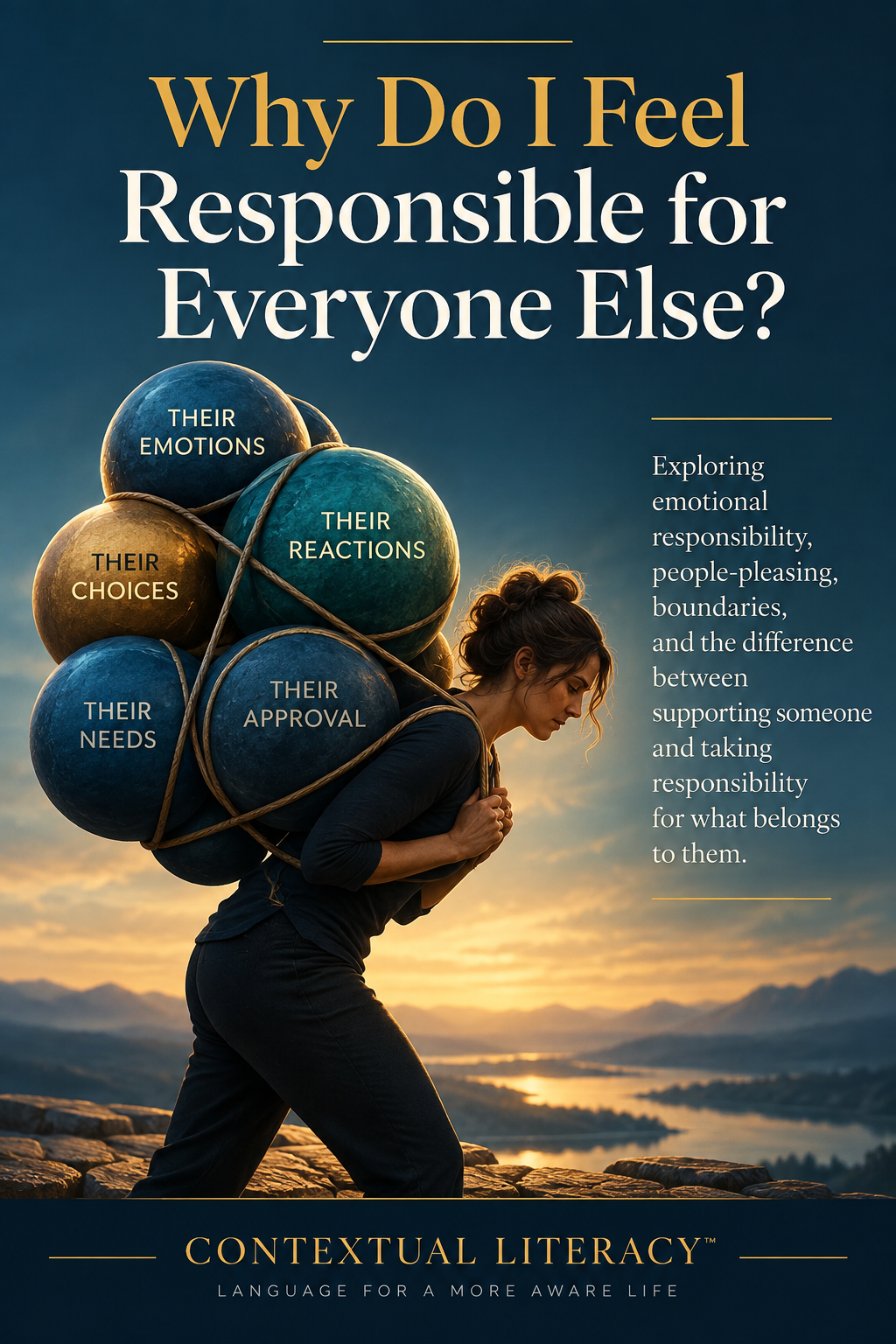
Why Do I Feel Responsible for Everyone Else? Understanding False Responsibility
When someone else is disappointed, struggling, or uncomfortable, do you immediately feel responsible for making it better? Explore the difference between healthy responsibility and false responsibility—and how to recognize what actually belongs to you.
Have you ever noticed that another person’s discomfort can immediately feel like something you need to fix?
Someone is disappointed.
Someone needs something.
Someone doesn’t like your answer.
Someone you care about is struggling.
And almost automatically, your attention shifts away from:
What is happening here? and toward: What am I supposed to do about it?
That feeling of responsibility can be incredibly convincing. But feeling responsible and actually being responsible are not always the same thing. Responsibility can expand beyond what actually belongs to us. Healthy responsibility matters.
Our choices affect other people. We are responsible for our own behavior, our agreements, our words, and the repair required when we cause harm. But responsibility can quietly expand.
Instead of being responsible for how we communicate a decision, we begin feeling responsible for whether someone likes the decision.
Instead of supporting someone through a difficult experience, we begin feeling responsible for removing the difficulty.
Instead of considering another person’s needs, we begin treating those needs as more important than our own capacity.
This is where I use the idea of false responsibility.
False responsibility is the experience of taking ownership of something that doesn’t actually belong entirely—or sometimes at all—to you.
-So why does it feel so real to me?
Because patterns don’t have to be logical to become familiar.
If you’ve learned to accommodate people because it has repeatedly reduced tension, then your system may learn that accommodation works.
If explaining yourself has historically reduced conflict, you may feel compelled to keep explaining.
If being useful has created connection or approval, another person’s need may immediately activate your impulse to provide.
The behavior makes sense when we understand its context. That doesn’t mean we have to continue it automatically.
-It’s time to separate your part from their part
Try asking:
What is actually mine here?
Maybe your part is communicating clearly.
Their part may be deciding how they feel about what you communicated.
Your part may be offering reasonable support.
Their part may be deciding what to do next.
Your part may be honoring an agreement.
Their part may be managing their disappointment when you cannot offer more.
-This isn’t about becoming indifferent. It’s about making responsibility more accurate.
We want to leave intact Caring.
-One of the fears underneath this work can be:
If I stop taking responsibility for everyone, will I stop being a caring person? Acutally, no.
In fact, separating caring from carrying can make compassion clearer.
—You can care because you choose to care—not because someone else’s emotional state has automatically become an assignment.
You can be compassionate without assuming responsibility for everything compassion allows you to see.
Contextual Literacy™ puts language around the patterns shaping how we think, feel, and respond.
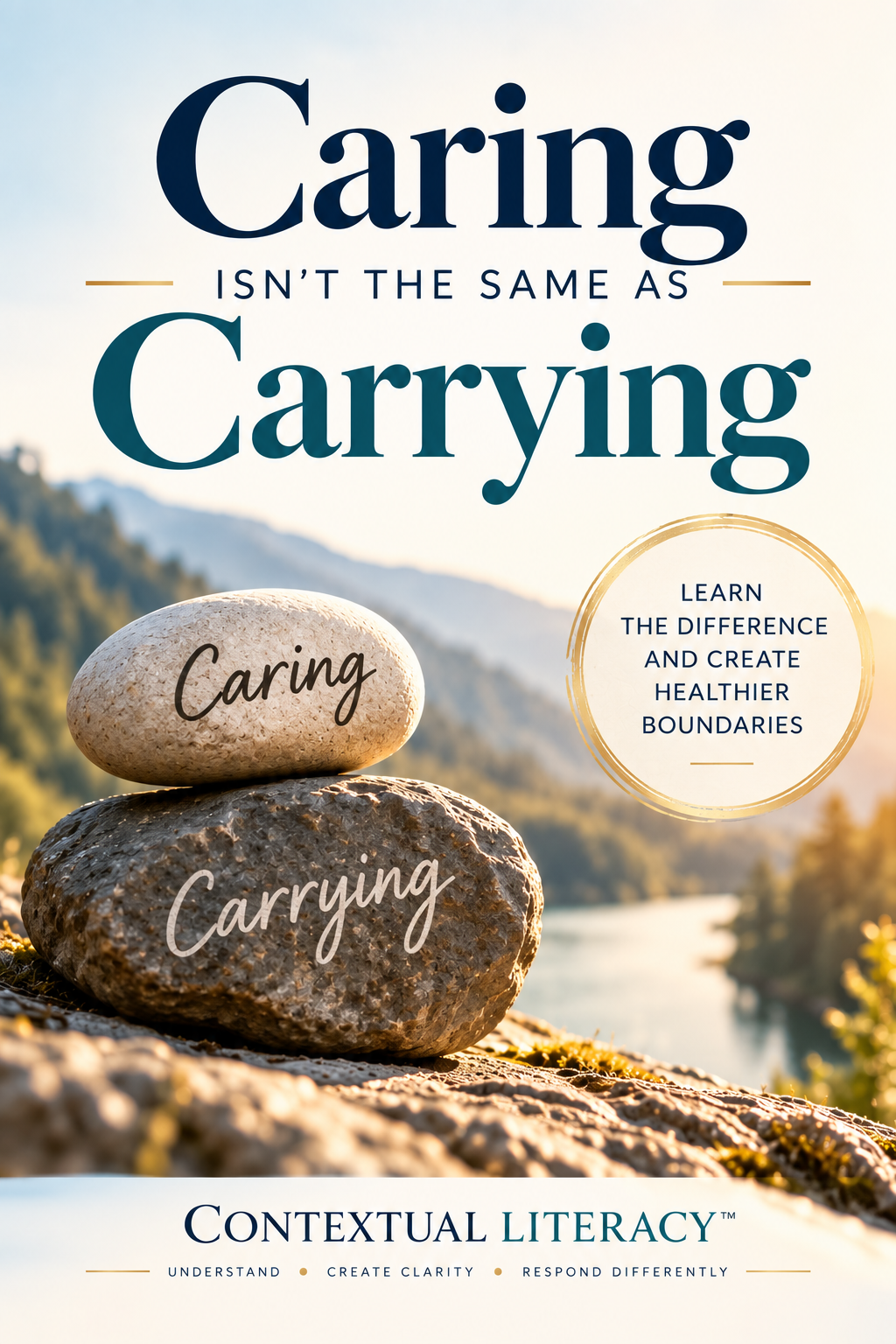
When Someone Else’s Feelings Don’t Belong to You
Caring about someone and carrying responsibility for their emotions are not the same thing. Explore how caring can quietly become carrying—and how recognizing what actually belongs to you can create healthier emotional responsibility and relationships.
Many people believe empathy means feeling what everyone else feels. But somewhere along the way, empathy can quietly become responsibility.
When someone we love is disappointed, angry, anxious, or overwhelmed, our bodies sometimes respond as though their emotions have become our assignment. We begin trying to solve, fix, convince, rescue, or change—not because they asked us to, but because our own nervous system has become uncomfortable.
The turning point isn’t learning to care less.
The turning point is learning ownership.
Say to yourself outload:
I can recognize your disappointment without becoming responsible for it.
I can acknowledge your anger without carrying it.
I can love you deeply while allowing your emotional experience to remain yours.
Emotional maturity isn’t becoming less compassionate. It’s becoming more accurate about what belongs to you and what belongs to someone else.
Sometimes the greatest act of regulation is simply saying:
“I recognize this feeling.
I respect this feeling.
But this feeling isn’t mine to carry.”
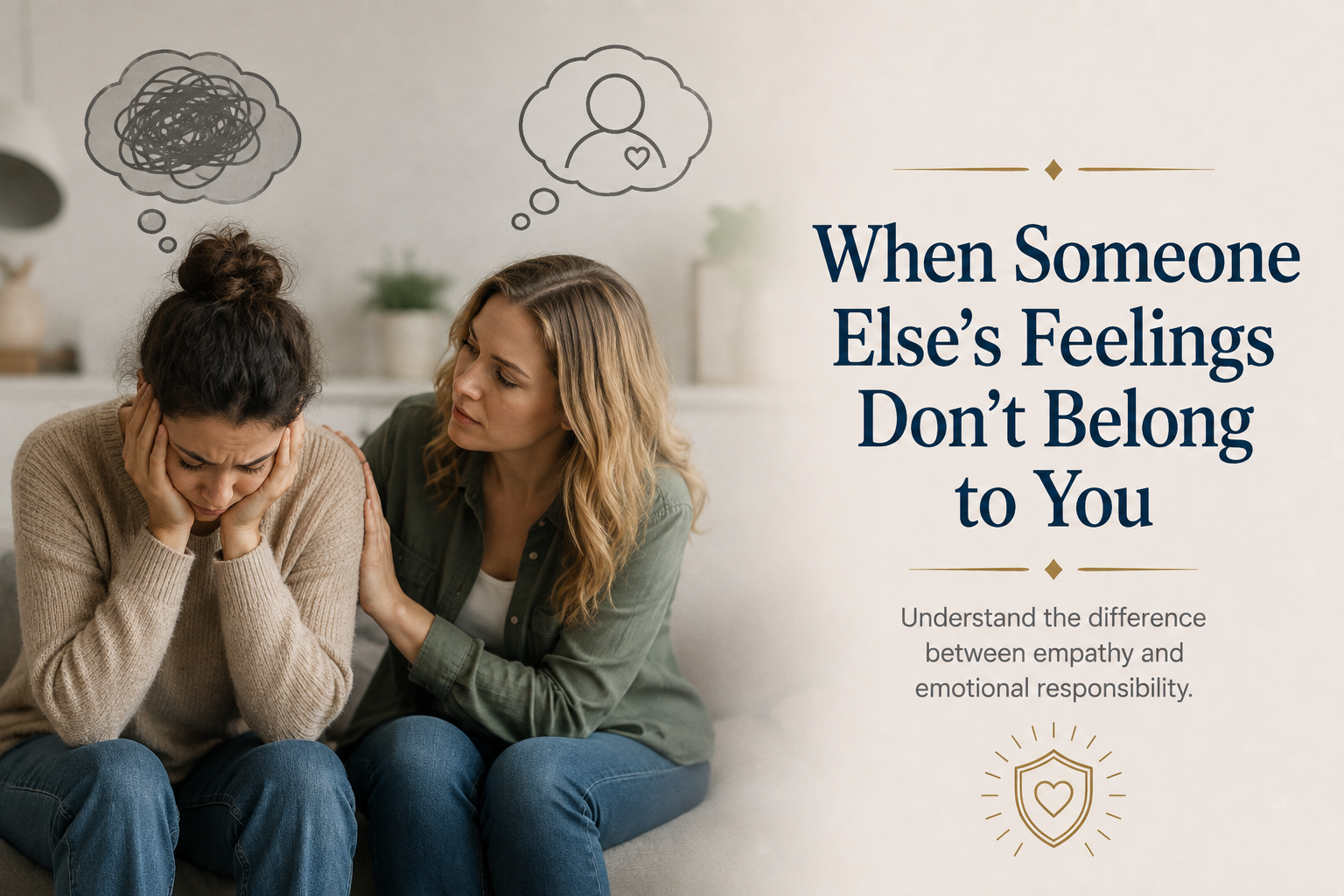
When Someone Else’s Feelings Don’t Belong to You
The turning point is learning ownership.
I can recognize your disappointment without becoming responsible for it.
I can acknowledge your anger without carrying it.
I can love you deeply while allowing your emotional experience to remain yours.
Emotional maturity isn’t becoming less compassionate. It’s becoming more accurate about what belongs to you and what belongs to someone else.
Many people believe empathy means feeling what everyone else feels. But somewhere along the way, empathy can quietly become responsibility.
When someone we love is disappointed, angry, anxious, or overwhelmed, our bodies sometimes respond as though their emotions have become our assignment. We begin trying to solve, fix, convince, rescue, or change—not because they asked us to, but because our own nervous system has become uncomfortable.
The turning point isn’t learning to care less.
The turning point is learning ownership.
I can recognize your disappointment without becoming responsible for it.
I can acknowledge your anger without carrying it.
I can love you deeply while allowing your emotional experience to remain yours.
Emotional maturity isn’t becoming less compassionate. It’s becoming more accurate about what belongs to you and what belongs to someone else.
Sometimes the greatest act of regulation is simply saying:
“I recognize this feeling.
I respect this feeling.
But this feeling isn’t mine to carry.”

Even Lions Rest Together
Sometimes awareness ins’t anxiety. Watching a lioness quietly observe her surroundings reminded me that calm attention and fear ar not the same thing.
Today I stood quietly watching a pride of lions at the zoo. A male lion and a lioness rested together on a large rock overlooking the entrance. The male appeared to be completely asleep, stretched comfortably in the warmth of the afternoon sun. The lioness rested beside him, but every so often she would slowly lift her head and survey the area around them before settling back into stillness.
What struck me was that she didn’t appear anxious or restless. She wasn’t searching frantically for danger or reacting to every movement around her. She was simply aware of her surroundings. Her attention was calm, measured, and purposeful.
As I continued to watch, the male lion stirred. Without fully waking, he reached toward the lioness, gently nuzzled against her, and settled even closer before drifting back to sleep. A little later, I noticed two more lions resting together nearby. The entire pride was at ease.
It made me stop and think.
These are among the strongest animals on earth. They have little reason to fear what surrounds them, yet they still choose to remain close to one another. Their strength has not removed their need for connection. Instead, it seems to create the safety that allows them to rest together.
Watching them reminded me that perhaps we have misunderstood strength. We often associate it with independence, self-sufficiency, and the ability to carry every burden alone. Yet in nature, even powerful creatures find comfort in companionship. Strength and connection were never meant to compete with one another. Perhaps genuine strength is what makes connection possible.
The lioness also illustrated something I think we often misunderstand in ourselves.
Awareness is not the same as anxiety.
Many people assume that paying close attention to their surroundings means they are living in fear. We often confuse vigilance with wisdom or assume that becoming regulated means no longer noticing what is happening around us. Neither is true.
The lioness remained observant without becoming consumed by what she observed. She noticed her environment without appearing overwhelmed by it. Her awareness was steady rather than reactive. She demonstrated that it is possible to remain present without living in a constant state of alarm.
This distinction feels increasingly important in a world that continually demands our attention. We are surrounded by information, responsibilities, and uncertainty. It is easy to believe that staying prepared requires remaining tense. Yet the lioness suggested something different. She was fully aware without sacrificing her peace.
That observation aligns closely with one of the principles behind Contextual Literacy. Regulation is not the absence of awareness; it is the ability to observe without allowing every observation to become a threat. A regulated nervous system doesn’t ignore reality. Instead, it learns to distinguish between what simply deserves our attention and what truly requires our response.
Perhaps the most meaningful part of what I witnessed was the quiet trust within the pride itself. One lion remained observant while another slept deeply enough to rest without concern. There was no competition over who appeared strongest or most capable. Each simply occupied the role that was needed in that moment.
Human relationships often work the same way. There are seasons when we borrow another person’s steadiness. A calm parent helps regulate a frightened child. A trusted friend provides perspective during a difficult season. A supportive spouse creates enough safety for someone else to finally exhale after carrying too much for too long. We were never designed to navigate every moment of life alone.
As I walked away from the exhibit, I found myself thinking less about lions and more about people. Perhaps real security is not found in becoming unaware of the world around us. Perhaps it is found in developing the kind of inner steadiness that allows us to remain aware without becoming fearful, and in cultivating relationships where we can both offer and receive the quiet safety that allows another person to rest.
Even lions rest together.
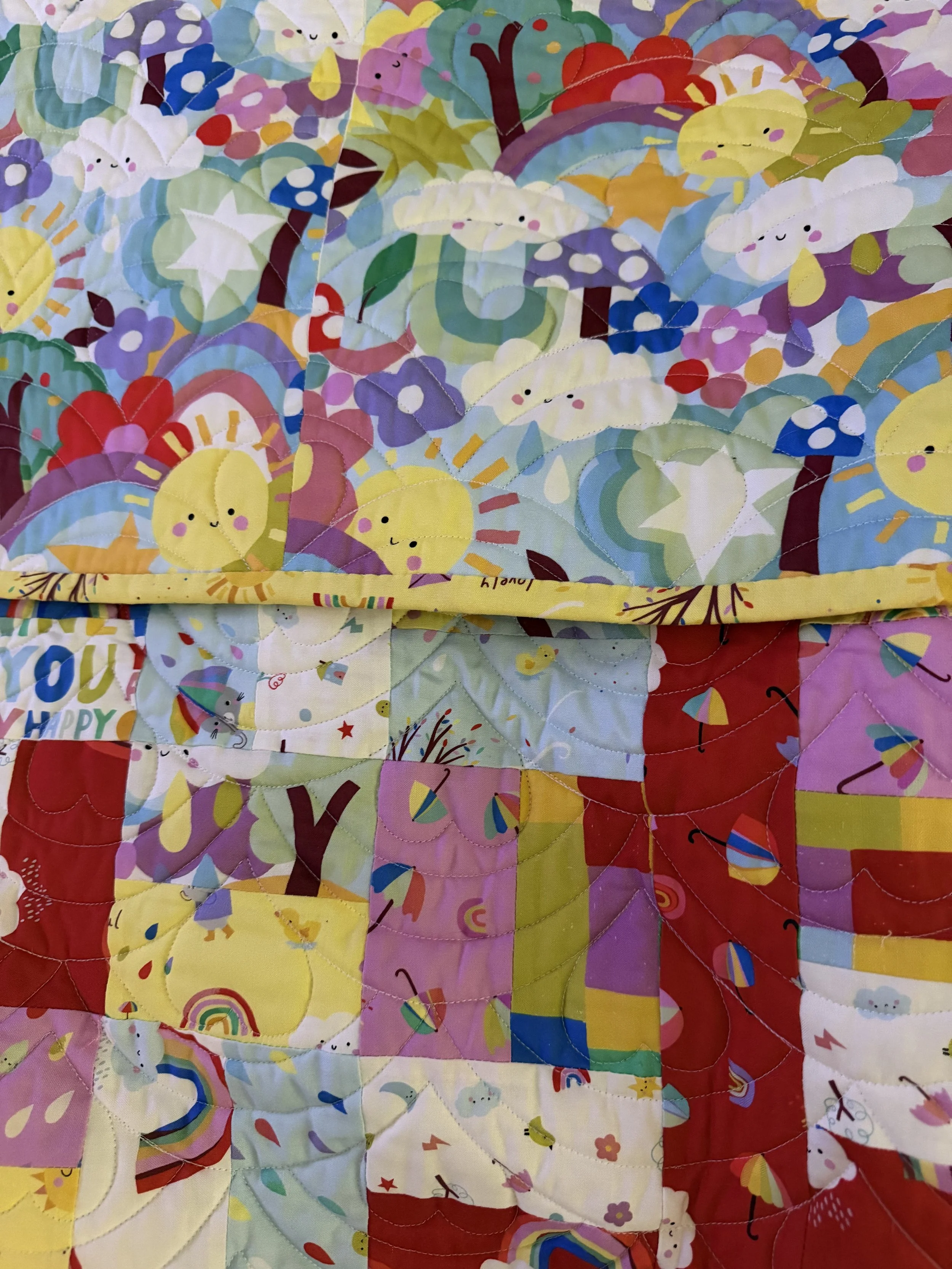
The Finished Quilt Deserves Admiration
Looking closely at a quilt reveals something easy to miss: no single piece tells the whole story. Sometimes the beauty we admire is only possible because of the countless individual pieces working together. A finished quit admired for its beauty, but its true value lies in the countess pieces stitched together over time. Our lives often become meaningful the same way.
The finished quilt deserves to be admired. But it’s the unseen piecework that made it possible and perhaps that’s true of us as well.
Let’s step back to observe the pattern. Have you ever held a quilt close enough to study it? If so, you notice individual fabrics, the tiny stitches, the seams, and the texture. One square may seem darker than the rest. Another pattern might feel like it doesn’t quite belong. If that’s all you can see, it’s easy to wonder why those pieces were chosen. But quilts aren’t meant to be understood from just a few inches away. They’re designed to be viewed as a whole. Only when you step back does the pattern begin to emerge.
Life has taught me that people are much the same. There are seasons that don’t seem to fit—experiences we would never have chosen, losses that feel like they interrupt the story of our life we thought we were writing. In the middle of those moments, it’s natural to ask, “Why is this part of my life?” The truth is, we often can’t answer that question while we’re standing inside it. Sometimes understanding only comes with time. What once looked like an isolated piece becomes part of a much larger design. A painful season may deepen our compassion, may redirect our path or become the challenge we never wanted but allowed us to understand someone else.
That doesn’t mean every hardship has an easy explanation. It simply reminds us that we don’t always have enough perspective to see the entire pattern.
Contextual Literacy invites us to pause before deciding that one piece doesn’t belong. Sometimes we need to step back, sometimes we need to give the story more time, and sometimes we discover, that the very pieces we questioned, became the ones that gave the quilt its depth, strength, and beauty.
The pieces we once wished weren’t part of our story often become the very ones that give it texture, strength and beauty. Not because they were easy. But because they became part of a pattern we couldn’t see while we were living it.

Not Every Sunflower Looks Like a Sunflower
A Teddy Bear Sunflower challenged everything I thought I knew about what a sunflower should look like. It made me wonder how often we mistake our expectations for reality—especially when it comes to people.
Today I discovered something I didn’t know existed: A Teddy Bear Sunflower.
If someone had shown me only a close-up of the bloom, I’m not sure I would have recognized it as a sunflower. I would have called it
Big Bird. It’s soft, fluffy, bright petals reminded me of my childhood friend on Sesame Street.
This flower didn’t match the picture I already had in my mind of a sunflower with the familiar dark center was instead layers of a shade different yellow petals.
This was softer, fluffier, rounder…different.
Yet it was exactly what it was created to be. This made me wonder how often we do typecasting with people.
We create a mental picture of what confidence should look like, what healing should look like, what leadership should look like. or what strength should look like —Then we meet someone who doesn’t fit our picture.
Instead of expanding our understanding, we assume something is wrong.
But perhaps the problem isn’t the person or the picture we’ve been carrying.
Contextual Literacy reminds us that categories are useful…
…until they become so rigid that we stop recognizing the diversity within them.
Not every sunflower looks the same.
Not every healthy family looks the same.
Not every successful person leads the same way.
Not every act of courage is loud.
Sometimes our greatest growth comes when life introduces us to something that doesn’t fit the image we expected.
The flower didn’t change, only my understanding of what a sunflower could be.
Maybe that’s what learning often is.
Not discovering something entirely new…
…but allowing our picture of the world to become a little bigger.
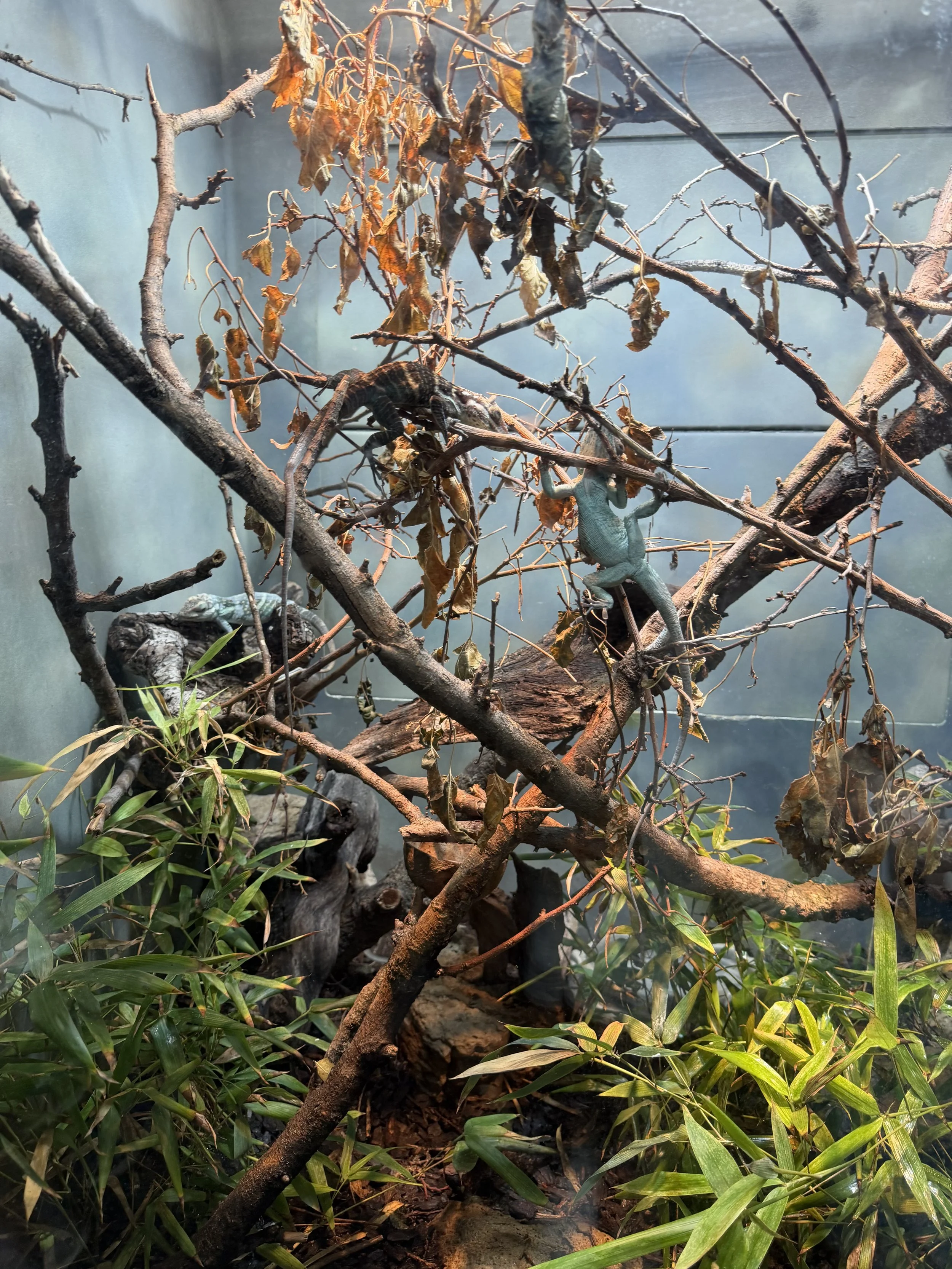
Sometimes What Looks Like Personality is Actually Camouflage
What if the traits you’ve always called your personality are actually ways you’ve learned to adapt? Explore the difference between identity and camouflage.
Today, I stood watching three lizards in the same habitat. At first, I thought they were all doing the same thing.
Camouflaging themselves. Then I peered in to have a closer look. One blended almost perfectly with the branches. If you weren’t paying attention, you would walk right past it. Another had climbed higher. Its pale blue body blended with the light and sky behind it, making I t almost disappear for a completely different reason. The third remained lower, tucked among weathered logs, moss and shifting shadows where light filtered through the leaves. It didn’t match the branches or the sky. It mirrored the darkness, the reflection of blues from the sky and imitated the light flickering in.
Three lizards. One environment. Three completely different adaptation. This made me wonder how often people do the same thing.
Some of us become invisible by staying quiet.
Some become successful because achievement feels safest.
Some become the caretaker.
Some become the comedian or blend into the crowd.
Some become independent because depending on others once felt too risky.
Others will stand out just enough to avoid being overlooked.
We’re all responding to our environments. Not because we’re pretending, but because our nervous system learns what has worked before. The adaptation isn’t the problem. The problem comes when we forget it was an adaptation.
Contextual Literacy invites us to ask a different question. Not, “why are they acting that way?” But rather, “What environment taught them this was the safest place to stand?” On occasion what looks like personality…is actually camouflage. Sometimes, what looks like camouflage…is simply a person doing the best they know how— they are just adapting to the world around them. Every adaptation makes sense when you understand the environment that shaped it.
Different Realities Exist Every Day
Over the past six hour, we drove from the winding country roads through small Midwestern towns-some with populations of barely 1,100 people into the heart of downtown Chicago. It wasn’t just a change of scenery. It was a change in reality.
For miles we passed cornfields, barns, grain bins, and farmhouses. When we were in Iowa, the conversations centered around the upcoming harvest. Families were preparing to freeze sweet corn that would feed multiple families through the winter. Community gatherings might include corn shucking, horseback riding, tarot shooting, county fairs or simply spending evenings on the porch watching the fireflies.
Then, mile by mile, the landscape changed. The roads widened, traffic increased and the buildings grew taller. Eventually we entered a City where millions of people share a completely different way of living.
Many residents rely on public transportation instead of driving everywhere. Living spaces are smaller, families seem to be smaller in numbers making large freezers and home food storage less practiced. Restaurants, coffee shops, theaters, museums, concerts and sporting events become part of everyday life.
Neither lifestyle is better.
They’re simply different realities.
We often assume everyone experiences the world the way we do. But our nervous system adapts to the environment we live in. What feel ordinary to one person many feel overwhelming—strangely quite—to someone else.
Someone raised in constant activity may find it a struggle to rest.
Someone raised in, open spaces may find the city crowded and exhausting.
Someone who has always lived surrounded by people may feel isolated in the country.
None of those experiences are good or bad, right or wrong. They are simply adaptations to the different environments.
Contextual Literacy is the ability to recognize that before we judge ourselves—or someone else. Sometimes expanding our understanding doesn’t require a change in our beliefs. It could be that it simply requires recognizing that someone else has spent a lifetime in a complex different reality.
The Information Was There All Along —You Were Just Moving Too Fast to Realize It.
There is a whole layer of your own experience that most people never access. Not because it’s not there, but because you’ve made a habit of moving too quickly from your feeling into your explanation. We’ve talked about the PAUSE. We are talking about it again.
Between the feeling and the explanation, there is this brief, often overlooked, precious moment. The moment where the body’s signals are present and available in a situation. The very real information is there, not the story your mind has built around the narrative. This is the feeling it self prior to you naming it.
This information is more than accurate. It is the foundation for the kind of genuine clarity that thinking alone can never quite reach. For most of us we move right past that moment too quickly. The body barely registers the signal before we are already explaining it. This is a moment for the Mind to Stand-Down and let the body finish it’s sentence.
How? By Observation. Slowing down long enough to be present for the moment. Notice what is actually there before interpretation takes over. This week we’re clearing the patterns that have made that difficult. The patterns that have put that rush in our step. That need for explanation. We are releasing the habit of mistaking analysis for understanding.
Why? Because what you’ve been missing has been there all along. Right there in the PAUSE. In the moment you’ve been in a rush to pass by.
Come practice with us. Find us @contextualliteracy on Youtube, Facebook or Instagram.
Three Free Clearing Practices available Here.
The Pattern that Keeps Showing Up — It'sNot Who You Are
Most people, at some point, have looked at their own life and thought — why does this keep happening? Different circumstances. Different people. Same outcome. Same feeling at the end of it. That's not bad luck. That's not a character flaw. That's a nervous system running a pattern it built to manage something — and applying that pattern consistently, regardless of whether the current situation actually warrants it. Here's the thing about patterns. They made sense once. They were built in response to something real.
Your nervous system learned what to expect and how to respond, and it got very efficient at that response. So efficient that it now runs automatically — before you've had a chance to choose anything different. The shutdown before you've decided to shut down. The bracing for what's about to go wrong even when everything is fine.
The relationship dynamic that keeps showing up in different packaging. The same conflict wearing a different face. These are not evidence that something is wrong with you. They are evidence that your nervous system is doing exactly what it was built to do — protect you according to what it learned. The work is not self-blame. It's recognition. Because you can't navigate a pattern you can't see. And once you can see it — clearly, without judgment — it becomes something you can actually work with. This week we're clearing what has kept those patterns running. And if this is landing close to home, my book What Your Body Knows is available on June 10th at ContextualLiteracy.com.Want to explore this further? Get the three free guided clearings and weekly Nervous System Journal
Observation Creates Clarity—It’s What You’ve Been Missing
There is a whole layer of your own experience that most people never access—not because it isn’t there, but because the habit of moving too fast from the initial feeling to rushing to finding the explanation means a pause doesn’t happen. This pause should be long enough to actually see the pattern.
Observation slows that sequence down just enough for the real information to surface. Not the story the mind has built around the feelings. The actual signals the body is sending before the interpretation begins. What then becomes visible thru that sustained observation, will then change things. Patterns that were invisible from inside a single experience become recognizable across multiple ones. Feelings that felt vague and formless but were there, maybe even heavy and awkward, start to have edges. Reaction that once seemed random start to have a reason.
This week we’re clearing what has kept the layer invisible—the rush to explain, the discomfort of staying with something without resolving it, the habit of skipping straight to the conclusion before the information is fully in.
Because what you’ve been missing—it’s been there all along. You just needed to slow down long enough to see it.
Want to go deeper? Get the three free guided clearings and weekly Nervous System Journal
What Calm Actually Feels Like — and How to Get There When You Need It
Most people know they're supposed to calm down before navigating something difficult. What most people don't know is what calm actually feels like in their body — or how to get there reliably when they need it most.
Regulation isn't a flat emotionless state. It's a settled aliveness — where you can feel what's present without being swept away by it. Where your thinking is genuinely available. Where your own wisdom is actually accessible. And the path there doesn't start in the thinking. It starts in the body. Breath. Sensation. Touch. Pressure. Movement. These communicate directly with the nervous system in a language it understands faster and more reliably than any amount of self-talk.
Most of us have experienced regulation without having a name for it — that moment when something in you just settled, the tightness released, the thoughts slowed, and you felt like yourself again. It happened. Your body got there.
This week we practice getting there on purpose. Because the conversations that go well, the decisions that become clear, the situations that feel navigable — these don't happen because the circumstances were easier. They happen because of the state you arrived in. Settled changes what's possible. And your body already knows how to get there. This week's clearing sequences are built around helping you find that state more reliably. And if you want the full framework for working with your nervous system and emotional patterns, my book What Your Body Knows is available now at ContextualLiteracy.com. Get the three free guided clearings.
You Can Understand Something Completely and Still Feel the Weight Of It
There's a distinction that changes everything once you understand it. Understanding something and releasing it from your body are not the same thing. You can process something thoroughly — in therapy, in reflection, in conversation — understand exactly where it came from, make genuine peace with it in your mind — and your body can still be holding it. Still carrying the weight. Still producing reactions that feel bigger than the current moment warrants. Because mental processing and body release require different conditions.
Most healing approaches focus heavily on the first and barely touch the second. Your nervous system doesn’t store unresolved stress like a file in a cabinet. It stores it like an active program still running in the background. Ready to be used at any moment, taking up space, and taking up enery.. Active patterns stay active until something helps them complete. And completion requires the body to receive a signal that it's safe to let go now. That what it has been holding in readiness is no longer necessary..
That's what emotional release work is actually about. Not endless processing or repeated analysis. Giving the nervous system the safety and the signal it needs to release what it has been carrying — and make room for something new. This week's clearing sequences are built around exactly that.
If this resonates deeply with you — if you recognize the weight that has become your normal, or the healing that helped your mind but not your body — I want you to know that this is the heart of what Emotional Release and Essential Oils is about. The full framework for this work is available now at ContextualLiteracy.com. You've been carrying this long enough. Want to know more? Get the Three Free Clearing Practices
The Feeling You Talked Yourself Out Of—It Was Right.
There's a particular kind of regret that comes from overriding what your body already knew. You felt it. Maybe it was that sense that something didn't feel alive when you imagined it — even though it looked right on paper. Maybe it was a persistent drain in a relationship you kept explaining away. Maybe it was a settled knowing about something that didn't make complete logical sense yet. And then you talked yourself out of it. Because you couldn't explain it. Because the logic said something different. Because you hadn't yet been given permission to trust what your body was already communicating.
Most of us were taught to lead with our thinking. To justify our feelings before we trust them. To override the signal if we can't back it up with evidence. But your nervous system is one of the most sophisticated information processing systems that exists. It reads your environment, your relationships, your situations — and it reports back through physical signals, through feelings, through a knowing that arrives before the words do. When we consistently dismiss that communication we cut ourselves off from some of our most accurate and useful information. This week I want to invite you into one practice.
Before you make a decision, enter a situation, commit to something — check in with your body first. Not your thoughts about it. Your body. Is the light on? What is it communicating before your mind takes over? That information is worth something. It has always been worth something. If this is resonating and you want to go deeper — my book What Your Body Knows is available on June 10th at ContextualLiteracy.com.Want to explore this further? Get the three free guided clearings and weekly Nervous System Journal reflections at this link: contextual-literacy-clearings.subscribepage.io
What Seven Weeks of Nervous System Literacy Actually Produces
Seven weeks ago, we began with a single idea: the body organizes experience before the mind explains it. Everything since has built on that foundation.
The nervous system scans for patterns. Stored stress influences present reactions. Regulation creates conditions for clalrity. Observation makes experience legible. Confusion has structure. And now—understanding that actually changes response.
That last piece is the one that integrates everything else. Because understanding without application stays in the category of interesting information. It is the understanding that has been practiced—tested against actual emotional experience, refined through observation, applied in real situations—that begins to change the texture of daily life.
The change is not dramatic. It does not announce itself it is a half-second of recognition before a habitual response would have arrived. A moment of ‘I know this pattern” before the pattern plays out. The moment is small. What it makes available is BIG.
The seven weeks are a foundation. The work continues from here—in the actual texture of your daily experience, with the actual patterns your nervous system carries. But you now have a different kind of literacy for that work.
That is what contextual literacy actually is: not a body of knowledge, but a developing capacity. And your capacity, applied consistently, compounds into much greater outcomes.
Continue this work here. If this is the first you’ve seen it, go back into the blogs. Join our facebook community to learn tidbits daily, catch the YouTube Channel for more teaching or grab a book.
What Looks Like Chaos—and What it Actually Is
Most people who experience recurring emotional difficulty describe it the same way: it feels random. It comes from nowhere. There is no predicting it, no logic to it, no way to prepare.
That experience is real. But the randomness is often more apparent than actual.
Emotional confusion tends to follow patterns. Cycles of activation that arrive on a predictable rhythm. Consistent responses to specific types of situations or conversations. Recurring difficulty at particular times a year. What feels like chaos is frequently a structured nervous system response that has not yet been identified.
The nervous system does not produce random reactions. It responds according to what it has learned when the learning produces confusion. The confusion itself follows the logic of the pattern.
This week, I want to invite you to look for the structure in any recurring emotional difficulty you carry. Not to resolve it—just to describe it. What does it feel like? When does it tend to arrive? What reliably precedes it? That description is the beginning of something more workable than confusion.