

Every event we host is designed with intention, from the atmosphere we create to the way each session flows.
Lost in Translation™
Understanding the Words Behind the Conversation
Welcome
Have you ever heard someone use a word that everyone else seemed to understand—but you weren’t quite sure what they meant? Maybe you’ve realized the same word can mean something completely different depending on who’s using it.
That’s the purpose of Lost in Translation™. This growing reference library explores common words and phrases used in wellness, neuroscience, psychology, spirituality, and personal growth.
My goal isn’t to tell you what to believe. It is help us better understand what people are actually communicating when they use these words. Many disagreements don’t begin because people are speaking different languages. They begin because they’re using the same words–but assigning different meanings to them. When we slow down long enough to understand the context behind a word, conversations become clearer. Curiosity replaces assumptions. Understanding becomes possible. That’s where Contextual Liteacy™ begins.
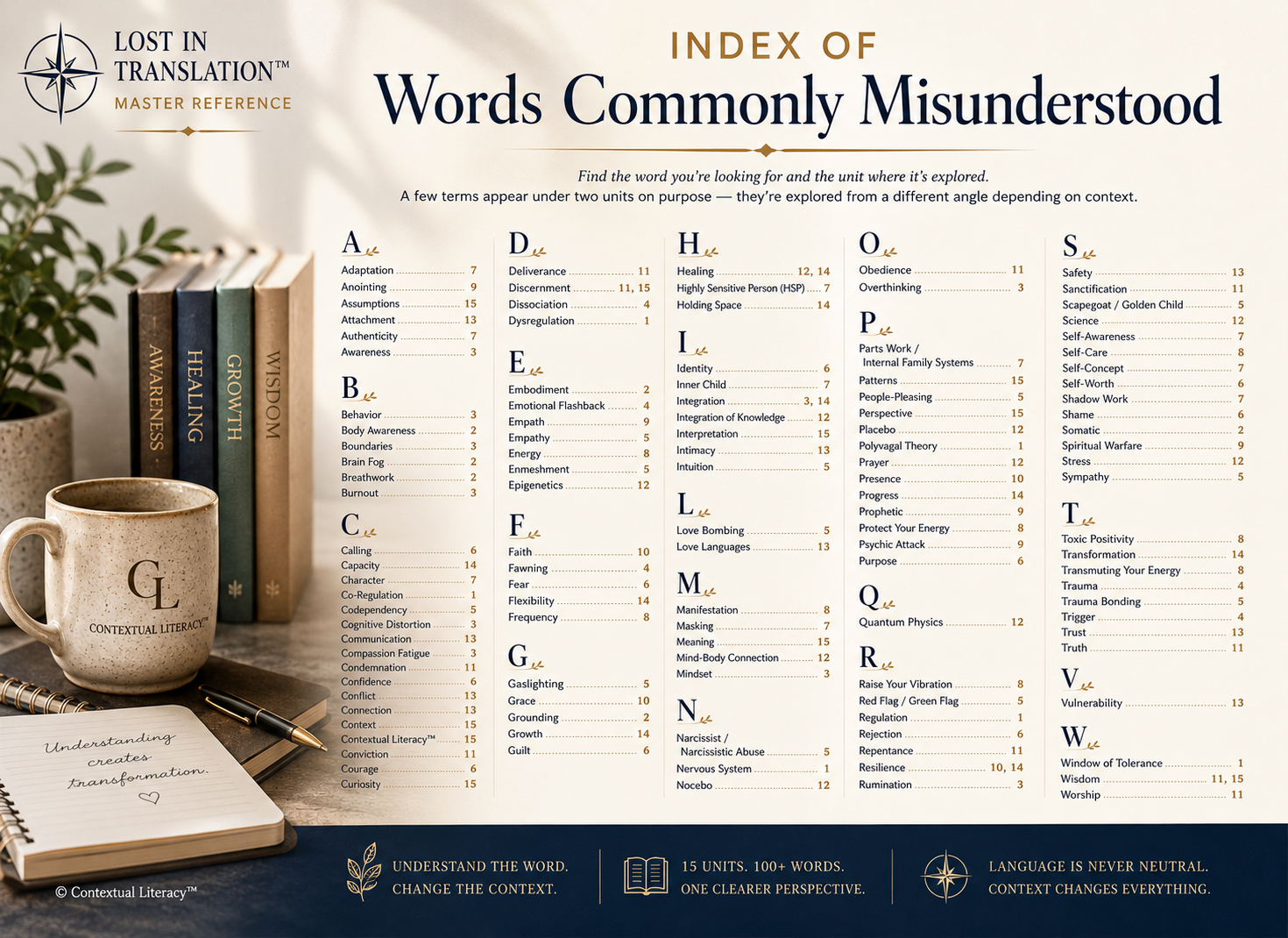
Inside this library you’ll find words organized into sixteen learning units. Each unit explores a different are of human experience–from the nervous system and emotional regulation to relationships, identity, spiritual formation, growth, and the larger patterns that shape how we understand ourselves and others. These entries are not designed to tell you what to think. They are designed to help you recognize how words are used. How meanings change across different communities, and how context shapes interpretation.
Whether you’re here because you’re exploring personal growth, supporting someone else, studying emotional health or simply trying to make better sense of today’s conversations, I hope this library gives you language that creates greater clarity, curiosity, and connection.
Choose a word then scroll down for units to begin exploring the words behind the conversation.

Unit 1 — The Nervous System
Understanding the system that shapes every experience.
Nervous System
In Simple Terms: The nervous system is the body’s communication network. It constantly gathers information from both inside and outside the body, helping us respond to our environment, maintain internal balance, and support everything from breathing and movement to thoughts, emotions, and relationships.
Common in: neuroscience, medicine, psychology, trauma-informed care, mental health, education, Christian faith, and everyday conversation.
How People Commonly Use This Word: People often use the phrase nervous system when discussing stress, anxiety, trauma, emotional regulation, or physical health. Scientifically, it includes the brain, spinal cord, and nerves throughout the body, receiving and processing information to coordinate thinking, feeling, moving, learning, healing, and adapting. Within psychology and trauma-informed care it’s discussed in relation to safety, regulation, and survival responses. Within Christian communities, some view it simply as part of God’s design, while others explore how caring for it supports prayer, rest, and healthy relationships.
Where Confusion Happens: The nervous system is often confused with emotions — emotions involve the nervous system but are only one part of a larger process. Another misunderstanding is believing it only responds to actual danger; in reality it responds to what it perceives as safe, dangerous, or uncertain, shaped by past experience. People also sometimes use “my nervous system is dysregulated” to explain every difficult emotion or behavior, when thoughts, beliefs, relationships, and choices also shape our responses.
Contextual Literacy™ Perspective: When I use the phrase nervous system, I am not describing something broken — I am describing something continually working. Instead of “What’s wrong with me?” I ask “What might my nervous system be responding to?” Within Contextual Literacy™, the nervous system is a source of information, not an enemy to overcome. Understanding does not replace responsibility — it creates a wiser starting point for growth.
Reflection: Your nervous system has been learning from every experience you’ve ever had. Some strengthened resilience, others increased sensitivity — neither defines your future. Awareness allows you to respond with wisdom rather than simply reacting from patterns you may never have realized were there.
Reflection Question: When my body reacts strongly to a situation, do I immediately judge myself — or do I become curious about what my nervous system may be responding to?
Contextual Literacy™ Principle: Before deciding whether you agree or disagree… ask what the person means when they use this word.
Regulation
In Simple Terms: Regulation is the nervous system’s ability to adapt to life’s experiences while maintaining or returning to a state of balance. It does not mean feeling calm all the time — it means having the flexibility to respond to challenges and gradually recover afterward.
Common in: neuroscience, psychology, trauma-informed care, mental health, child development, Christian faith, personal growth, and everyday conversation.
How People Commonly Use This Word: People often use “regulation” about emotions, stress, behavior, relationships, or mental health — “trying to regulate their emotions,” or a child “learning emotional regulation.” Within neuroscience, it’s the body’s ability to maintain stability while adapting. Within psychology, a regulated person still feels fear, sadness, anger, and joy, but those experiences don’t take over their ability to think and relate. Christian faith doesn’t typically use the word theologically, but many recognize practices like prayer, rest, and gratitude support emotional steadiness.
Where Confusion Happens: Regulation is often confused with being calm — a regulated nervous system isn’t always peaceful, it’s one that can move through emotion and still recover. It’s also confused with controlling or suppressing emotion, when healthy regulation allows us to feel without being controlled. People also assume it’s a trait some have and others don’t, when it’s shaped by biology, relationships, sleep, stress, and support, and can be strengthened.
Contextual Literacy™ Perspective: Regulation describes flexibility, not perfection. Instead of “Why can’t I stay calm?” I ask “How well am I able to recover when life becomes difficult?” The goal is not to never become dysregulated — it’s to spend less time there and become more capable of finding the way back.
Reflection: A healthy life isn’t one without emotional highs and lows — it’s one that develops the ability to return to balance after being stretched. Growth often looks less like avoiding difficulty and more like recovering with increasing confidence.
Reflection Question: When life becomes challenging, do I expect myself to never struggle — or am I learning to recognize and strengthen my ability to return to balance?
Contextual Literacy™ Principle: Before deciding whether you agree or disagree… ask what the person means when they use this word.
Dysregulation
In Simple Terms: Dysregulation occurs when the nervous system has difficulty adapting to or recovering from stress, causing thoughts, emotions, behaviors, or physical responses to feel more intense, less flexible, or harder to manage than we’d like.
Common in: neuroscience, psychology, trauma-informed care, mental health, child development, Christian faith, personal growth, and everyday conversation.
How People Commonly Use This Word: People describe feeling overwhelmed, reactive, shut down, anxious, irritable, or numb. It’s often discussed alongside chronic stress, trauma, anxiety, or overwhelming experiences, but it isn’t limited to a diagnosis — everyone experiences periods of it. Christian communities may describe similar experiences as fear, distress, or weariness.
Where Confusion Happens: Dysregulation is often confused with bad behavior, when an overwhelmed nervous system genuinely reduces the ability to think clearly or make thoughtful decisions. It’s also mistaken for a permanent condition rather than a state people move in and out of. And it’s sometimes used to remove all personal responsibility, when compassion and accountability can exist together.
Contextual Literacy™ Perspective: Dysregulation isn’t failure — it’s information. Instead of “Why did I react that way?” I ask “What was happening that made my nervous system respond this way?” The goal isn’t pretending we never become dysregulated — it’s recognizing it sooner and strengthening our capacity to return to regulation.
Reflection: Every person becomes dysregulated at times. What changes with growth isn’t whether it happens, but how quickly we recognize it and how compassionately we respond.
Reflection Question: When I notice myself becoming overwhelmed, reactive, or shut down, do I immediately criticize myself — or pause long enough to become curious about what my nervous system may be communicating?
Contextual Literacy™ Principle: Before deciding whether you agree or disagree… ask what the person means when they use this word.
Co-Regulation
In Simple Terms: Co-regulation is the process of one person’s calm, safe, and supportive presence helping another person’s nervous system move toward regulation. It’s one of the primary ways humans learn emotional regulation throughout life.
Common in: neuroscience, psychology, child development, trauma-informed care, mental health, relationships, Christian faith, and everyday conversation.
How People Commonly Use This Word: Most often used in parenting, counseling, education, marriage, friendships, and healthy relationships. In child development, caregivers help children manage overwhelming emotions before children can self-regulate. Adults also influence one another’s nervous systems throughout life — a calm, present person can reduce another’s distress. Christian faith reflects similar principles through encouragement, compassionate presence, and community.
Where Confusion Happens: Co-regulation is often confused with dependence — helping regulate someone isn’t the same as becoming responsible for their emotions. It’s also mistakenly seen as something only children need, when adults continue to influence one another throughout life. And it’s sometimes mistaken for fixing someone’s emotions, when it’s more about offering a calm, safe presence while they regain capacity.
Contextual Literacy™ Perspective: Instead of “How do I fix this person?” I ask “How can my presence contribute to greater safety, steadiness, and connection?” We influence one another through tone, pace, attention, and presence — not just words.
Reflection: The people you feel safest with usually aren’t the ones with perfect answers — they’re the ones whose presence lets you breathe a little easier and remember you’re not alone.
Reflection Question: When people leave an interaction with me, does my presence generally contribute to greater calm and safety — or to greater tension?
Contextual Literacy™ Principle: Before deciding whether you agree or disagree… ask what the person means when they use this word.
Window of Tolerance
In Simple Terms: The Window of Tolerance is the range in which a person’s nervous system can respond to life’s challenges while still thinking clearly, managing emotions, connecting with others, and making thoughtful decisions.
Common in: psychology, neuroscience, trauma-informed care, mental health, counseling, education, personal growth, and everyday conversation.
How People Commonly Use This Word: Introduced by Dr. Dan Siegel to describe the range of nervous system activation where a person functions effectively. Exceeding it can move someone into hyperarousal (anxiety, panic, racing thoughts) or hypoarousal (numbness, exhaustion, withdrawal). Supportive relationships, sleep, movement, and spiritual practices may help expand the window over time.
Where Confusion Happens: People often assume they should always stay inside their window — unrealistic, since everyone moves outside it at times. Others believe the window is fixed, when research suggests capacity changes with stress, illness, and support. It’s also confused with emotional weakness, when moving outside your window is information about current capacity, not failure.
Contextual Literacy™ Perspective: Instead of “Why can’t I handle more?” I ask “What increases my capacity to respond well?” Growth is measured by how well we recognize our limits and gradually strengthen our ability to remain present.
Reflection: Every person has seasons when life feels manageable and seasons when small things feel overwhelming. Your nervous system is continually providing information about your current capacity.
Reflection Question: What situations consistently help me remain within my Window of Tolerance, and what situations most often push me beyond it?
Contextual Literacy™ Principle: Before deciding whether you agree or disagree… ask what the person means when they use this word.
Polyvagal Theory
In Simple Terms: A scientific theory proposing that the autonomic nervous system does more than regulate automatic body functions — it also influences how we experience safety, connection, protection, and survival.
Common in: neuroscience, psychology, trauma-informed care, counseling, mental health, education, personal growth, and everyday conversation.
How People Commonly Use This Word: Developed by Dr. Stephen Porges, the theory proposes the autonomic nervous system continuously evaluates whether the environment feels safe, dangerous, or life-threatening — largely outside conscious awareness. It describes three broad patterns: safety (connection, clear thinking), danger (mobilized fight/flight), and overwhelming threat (shutdown, numbness).
Where Confusion Happens: It’s often treated as established fact rather than a theory — a valuable framework, but one some researchers still question or refine. It’s also sometimes used too rigidly, as if every response fits neatly into one category, when human nervous systems are far more complex.
Contextual Literacy™ Perspective: Instead of “Is this theory completely right or wrong?” I ask “What does this framework help us understand, and where are its limitations?” Theories are tools that help us organize observations and ask better questions — not the only explanation we’re willing to consider.
Reflection: Every model simplifies reality. That doesn’t necessarily make it wrong — it reminds us no single framework captures the full complexity of being human.
Reflection Question: When I learn a new theory, do I immediately accept or reject it — or do I thoughtfully consider both its strengths and limitations?
Contextual Literacy™ Principle: Before deciding whether you agree or disagree… ask what the person means when they use this word.

Unit 2 — Somatic Language
Learning to recognize and understand the body’s signals, sensations, and patterns.
Somatic
In Simple Terms: Somatic refers to the body and the lived experience of being in a body — approaches that recognize how physical sensations, movement, posture, breathing, and bodily awareness contribute to thoughts, emotions, and overall well-being.
Common in: neuroscience, psychology, trauma-informed care, mental health, physical therapy, integrative health, Christian faith, and everyday conversation.
How People Commonly Use This Word: From the Greek soma, meaning body. In medicine, it simply refers to the body. In psychology and trauma-informed care, somatic approaches recognize experience is processed through sensations, physiology, and movement — not just thoughts. Christian practices like prayer, kneeling, or walking naturally incorporate body awareness for some.
Where Confusion Happens: Somatic is often confused with emotions, when it refers specifically to bodily experience. It’s also mistakenly thought to require reliving painful memories, when many somatic practices focus on present-moment awareness and safety. And people sometimes assume anything labeled “somatic” is automatically proven or unproven — evidence varies widely across practices.
Contextual Literacy™ Perspective: Instead of only “What am I thinking?” I also ask “What is my body experiencing right now?” The body isn’t separate from the mind, nor the only source of information — it’s one important part of the larger story.
Reflection: We’re taught to notice what we think far more than what we feel physically, yet our bodies are constantly providing information worth learning to observe with curiosity.
Reflection Question: When something significant happens, do I notice only my thoughts — or also become curious about what my body may be communicating?
Contextual Literacy™ Principle: Before deciding whether you agree or disagree… ask what the person means when they use this word.
Grounding
In Simple Terms: The practice of intentionally directing attention to the present moment through the body, senses, or surroundings, to increase awareness, promote regulation, and reconnect with the here and now.
Common in: psychology, trauma-informed care, mental health, mindfulness, neuroscience, integrative health, Christian faith, and everyday conversation.
How People Commonly Use This Word: Used to describe techniques that reduce overwhelm, anxiety, panic, or dissociation — noticing feet on the floor, naming five things you can see, focusing on breath. In Christian faith, quiet prayer, Scripture meditation, and worship can serve a similar grounding function.
Where Confusion Happens: Grounding is often confused with avoiding emotions, when it’s actually about creating enough steadiness to experience feelings without being overwhelmed. It’s also mistaken for forcing calm — grounding invites awareness; calm may or may not follow.
Contextual Literacy™ Perspective: Instead of “How do I make these feelings disappear?” I ask “How can I become more aware of what is true in this moment?” Grounding isn’t escaping reality — it’s becoming more fully present to it.
Reflection: Many of life’s hardest moments pull our attention away from where we are. Sometimes the next wise step begins simply by noticing where we are and taking one breath.
Reflection Question: When life feels overwhelming, what practices help me reconnect with the present rather than the past or future?
Contextual Literacy™ Principle: Before deciding whether you agree or disagree… ask what the person means when they use this word.
Breathwork
In Simple Terms: The intentional practice of changing or becoming aware of your breathing to influence your physical, mental, or emotional state.
Common in: neuroscience, psychology, trauma-informed care, medicine, mental health, athletic performance, Christian faith, and everyday conversation.
How People Commonly Use This Word: Describes intentional breathing exercises supporting focus, relaxation, or stress reduction — some slow the breath for regulation, others increase alertness or performance. In medicine, breathing techniques support pulmonary rehab and pain management. In Christian faith, slow breathing naturally accompanies prayer and contemplative practice.
Where Confusion Happens: Breathwork is often mistaken for one specific technique, when it’s a broad category with varying goals and levels of scientific support. It’s also assumed to work the same for everyone — some with trauma histories or panic disorders may find certain techniques distressing, so it should be individualized.
Contextual Literacy™ Perspective: Instead of “Will this fix everything?” I ask “How might intentional breathing support my ability to respond more wisely right now?” It’s one practical tool among many — not a replacement for medical care or wise relationships.
Reflection: Breathing is something we do every moment without thinking about it — which may be why it’s so easy to overlook as one of the simplest ways to pause and respond with intention.
Reflection Question: When I begin to feel overwhelmed, do I notice my breathing — and what changes when I intentionally slow it down?
Contextual Literacy™ Principle: Before deciding whether you agree or disagree… ask what the person means when they use this word.
Body Awareness
In Simple Terms: The ability to notice and understand the physical sensations, movements, and signals your body is experiencing in the present moment — recognizing responses before they become overwhelming.
Common in: neuroscience, psychology, trauma-informed care, physical therapy, occupational therapy, mindfulness, Christian faith, and everyday conversation.
How People Commonly Use This Word: Noticing muscle tension, breathing, heart rate, posture, hunger, or fatigue — the subtle signals that often appear before we consciously recognize stress or emotion. Related to interoception and proprioception in neuroscience. In physical and occupational therapy, it supports movement and injury prevention.
Where Confusion Happens: Body awareness is often confused with body image — image is about appearance, awareness is about noticing function and signals. It’s also mistaken for constant analysis, when healthy body awareness is observational, not obsessive. Many people assume they’re naturally aware of their bodies when years of stress or busyness can disconnect that skill — it can be rebuilt with practice.
Contextual Literacy™ Perspective: Instead of “How do I make this feeling stop?” I first ask “What is my body trying to communicate?” The body becomes one source of information among many — not ignored, not in complete control.
Reflection: Your body has been communicating with you your entire life. The question isn’t whether it’s speaking, but whether you’ve learned to recognize its language.
Reflection Question: As I move through my day, how often do I pause long enough to notice what my body is communicating before I push through?
Contextual Literacy™ Principle: Before deciding whether you agree or disagree… ask what the person means when they use this word.
Brain Fog
In Simple Terms: A non-medical term for difficulty thinking clearly — problems with concentration, memory, mental clarity, word-finding, or feeling mentally “slowed down.”
Common in: medicine, neuroscience, psychology, mental health, chronic illness, hormonal health, trauma-informed care, and everyday conversation.
How People Commonly Use This Word: Not a diagnosis itself, but a symptom that can occur alongside many conditions — poor sleep, chronic stress, hormonal changes, nutritional deficiencies, chronic illness, or prolonged cognitive overload. Chronic stress can also narrow attention and make problem-solving require more effort.
Where Confusion Happens: Brain fog is often confused with low intelligence, when a person’s ability to access or process information is simply temporarily affected. It’s also assumed to have a single cause, when it can result from many overlapping factors. And it’s sometimes dismissed as laziness, when persistent or worsening brain fog deserves thoughtful evaluation.
Contextual Literacy™ Perspective: Instead of “What’s wrong with my brain?” I ask “What factors might be contributing to my difficulty thinking clearly right now?” Sleep, stress, nutrition, physical health, and relationships all matter.
Reflection: Most of us have days when thinking feels unusually clear and days when simple tasks require tremendous effort. Sometimes clarity returns not because we tried harder, but because we cared more wisely for the whole person.
Reflection Question: When my thinking feels cloudy, do I immediately blame myself — or pause to consider what factors may be contributing?
Contextual Literacy™ Principle: Before deciding whether you agree or disagree… ask what the person means when they use this word.
Embodiment
In Simple Terms: The experience of living with an awareness of your whole self — mind, body, emotions, relationships, and for many, faith — rather than living primarily from thoughts alone. It’s the practice of bringing what we know into the way we actually live.
Common in: psychology, neuroscience, trauma-informed care, somatic practices, Christian faith, leadership, personal growth, and everyday conversation.
How People Commonly Use This Word: In psychology, being connected to bodily experience rather than detached. In personal growth, moving beyond intellectual understanding to actually living it consistently. Within Christian faith, believers are encouraged not only to know truth but to live it.
Where Confusion Happens: Embodiment is often confused with body awareness — body awareness notices what the body is experiencing; embodiment is broader, integrating thoughts, emotions, values, and behavior into daily living. It’s also mistaken for achieving perfect alignment, when it’s a lifelong process.
Contextual Literacy™ Perspective: Instead of “Do I understand this?” I ask “Is this understanding becoming part of the way I live?” Knowledge has value; understanding becomes wisdom when it begins shaping how we think, respond, and live.
Reflection: Most of us know far more than we consistently practice. Growth happens in the space between understanding an idea and gradually living it more faithfully.
Reflection Question: What truth do I already understand intellectually that I am currently learning to live more consistently?
Contextual Literacy™ Principle: Before deciding whether you agree or disagree… ask what the person means when they use this word.

Unit 3 — Patterns & Behavior Language
Understanding what we do and why.
Awareness
In Simple Terms: Awareness is the ability to notice what is happening within you and around you without immediately reacting or judging. It’s the foundation of understanding, because we can’t thoughtfully respond to what we haven’t first recognized.
Common in: psychology, neuroscience, personal growth, leadership, Christian faith, counseling, education, and everyday conversation.
How People Commonly Use This Word: Becoming conscious of emotions, thoughts, sensations, behaviors, relationships, or environment. In psychology, increased awareness is considered a key first step toward personal growth. In leadership, it includes recognizing how our actions affect others.
Where Confusion Happens: Awareness is often confused with change — becoming aware of a pattern doesn’t automatically change it; growth still requires intentional practice. It’s also mistaken for constant self-analysis, when healthy awareness is observational, not obsessive.
Contextual Literacy™ Perspective: Instead of “How do I fix this?” I first ask “What am I noticing?” Awareness isn’t the finish line — it’s the doorway. Every meaningful change begins by seeing something more clearly than before.
Reflection: Many patterns operate quietly beneath our attention. The moment we notice them, new possibilities emerge — not because life instantly changes, but because we finally have the opportunity to respond intentionally.
Reflection Question: What pattern in my life have I been experiencing for a long time but am only now beginning to truly notice?
Contextual Literacy™ Principle: Before deciding whether you agree or disagree… ask what the person means when they use this word.
Behavior
In Simple Terms: Behavior is the observable way we respond to our thoughts, emotions, beliefs, environment, relationships, and experiences — including both what we do and, at times, what we choose not to do.
Common in: psychology, neuroscience, education, child development, Christian faith, leadership, relationships, and everyday conversation.
How People Commonly Use This Word: Speaking, withdrawing, helping, avoiding, working — all examples of behavior. In education and child development, behavior is often understood as a form of communication. Within Christian faith, lasting change is often described as beginning with transformation of the heart, not just external compliance.
Where Confusion Happens: Behavior is often confused with identity — it describes what someone is doing, not who they are. It’s also assumed to have one cause, when it’s often influenced by many interacting factors. And understanding a behavior’s cause doesn’t remove responsibility for learning healthier responses.
Contextual Literacy™ Perspective: Instead of “Why are they acting like that?” I first ask “What might this behavior be communicating?” Behavior is often the visible part of a much larger story.
Reflection: Every behavior tells a story — sometimes of growth, sometimes of protection, sometimes of a pattern that’s remained unchanged for years without ever being questioned.
Reflection Question: When I notice a behavior in myself or someone else, is my first response to judge it — or to become curious about what it may be communicating?
Contextual Literacy™ Principle: Before deciding whether you agree or disagree… ask what the person means when they use this word.
Boundaries
In Simple Terms: Boundaries are the healthy limits we establish to protect our well-being, clarify our responsibilities, and support respectful relationships. Healthy boundaries define what we are responsible for and what we are not.
Common in: psychology, relationships, counseling, leadership, Christian faith, mental health, personal growth, and everyday conversation.
How People Commonly Use This Word: Saying no, communicating expectations, protecting time for rest, or recognizing where one person’s responsibility ends and another’s begins. In leadership, boundaries create clarity around roles and accountability. Within Christian faith, boundaries aren’t the opposite of love — they often make healthy love possible.
Where Confusion Happens: Boundaries are often confused with walls — a wall keeps people out; a healthy boundary protects healthy relationships. They’re also mistaken for controlling others, when boundaries primarily govern our own actions. And setting them is sometimes seen as selfish, when they clarify which responsibilities are actually ours.
Contextual Literacy™ Perspective: Instead of “How do I get other people to change?” I ask “What is my responsibility here, and where does it end?” Boundaries create space for relationships built on honesty and mutual responsibility rather than guilt or control.
Reflection: Many people struggle with boundaries because they fear disappointing others. Yet relationships more often suffer because expectations were never communicated at all.
Reflection Question: When I feel overwhelmed in a relationship, do I assume I need to do more — or pause to consider whether clearer boundaries are needed?
Contextual Literacy™ Principle: Before deciding whether you agree or disagree… ask what the person means when they use this word.
Burnout
In Simple Terms: A state of physical, emotional, mental, or spiritual exhaustion that develops after prolonged stress, excessive demands, or inadequate recovery. It’s not simply being tired — it’s the gradual depletion of the resources needed to keep functioning well.
Common in: psychology, medicine, workplace health, neuroscience, mental health, Christian faith, caregiving, and everyday conversation.
How People Commonly Use This Word: Feeling completely drained, unmotivated, or emotionally exhausted after carrying responsibilities too long — common in work, parenting, caregiving, or ministry. Within Christian faith, it’s sometimes tied to overcommitment or neglecting Sabbath rest.
Where Confusion Happens: Burnout is often confused with ordinary fatigue — fatigue improves with rest; burnout often persists because it reflects prolonged depletion. It’s also mistaken for weakness or laziness, when it frequently affects highly capable, deeply committed people who kept giving after their resources were depleted.
Contextual Literacy™ Perspective: Instead of “How can I keep pushing?” I ask “What has my life been asking of me, and what have I been giving back to myself?” Sometimes the answer isn’t greater effort — it’s wiser boundaries, healthier relationships, or rest.
Reflection: A candle cannot give light after all the wax is consumed. We were created with limits — recognizing them is wisdom, not weakness.
Reflection Question: When I feel exhausted, do I ask how I can do more — or pause to ask what my mind, body, relationships, and spirit need to recover?
Contextual Literacy™ Principle: Before deciding whether you agree or disagree… ask what the person means when they use this word.
Integration
In Simple Terms: The process of bringing separate parts together so they function as a connected whole. In personal growth, it’s the ongoing process of applying what we’ve learned so our thoughts, emotions, behaviors, relationships, and values become increasingly aligned.
Common in: psychology, neuroscience, counseling, trauma-informed care, Christian faith, education, personal growth, and everyday conversation.
How People Commonly Use This Word: Making sense of new insights or difficult experiences so they become part of one’s ongoing story rather than remaining fragmented. In neuroscience, learning itself involves integration as new information links with existing knowledge. Within Christian faith, integration means allowing beliefs to shape everyday living.
Where Confusion Happens: Integration is often confused with completion, when it’s rarely a one-time event — it’s ongoing throughout life. It’s also mistaken for the same thing as intellectual understanding, when knowing and living aren’t the same.
Contextual Literacy™ Perspective: Instead of “What have I learned?” I ask “How is what I’ve learned changing the way I live?” Knowledge informs us; integration transforms us.
Reflection: Growth rarely happens because we discover one life-changing idea. More often, it happens because we consistently apply small insights over time until they shape our habits, relationships, and character.
Reflection Question: As I look back over what I’ve learned recently, what truth is beginning to move beyond knowledge and become part of the way I live?
Contextual Literacy™ Principle: Before deciding whether you agree or disagree… ask what the person means when they use this word.
Overthinking
In Simple Terms: Overthinking is the pattern of repeatedly analyzing a thought, decision, or worry beyond what’s actually useful — replaying, predicting, or rehearsing until clarity gets replaced by exhaustion.
Common in: psychology, neuroscience, mental health, personal growth, Christian faith, and everyday conversation.
How People Commonly Use This Word: Lying awake replaying a conversation, mentally rehearsing every possible outcome of a decision, or circling the same worry without reaching resolution. Often described casually (“I overthink everything”) as if it’s simply a personality trait.
Where Confusion Happens: Overthinking is often confused with being thorough or responsible — careful thought serves a decision; overthinking serves anxiety and rarely produces more clarity the longer it continues. It’s also treated as a fixed trait rather than a pattern that can be noticed and interrupted.
Contextual Literacy™ Perspective: Instead of “Why can’t I stop thinking about this?” I ask “What does this thinking pattern believe it’s protecting me from?” Overthinking often masquerades as problem-solving while actually avoiding the discomfort of uncertainty or action.
Reflection: More thinking rarely produces more peace. Often what’s needed isn’t a better answer, but permission to act without having one yet.
Reflection Question: When I notice myself circling the same thought again, is more analysis actually going to help — or has this become a substitute for action?
Contextual Literacy™ Principle: Before deciding whether you agree or disagree… ask what the person means when they use this word.
Rumination
In Simple Terms: Rumination is the repeated, passive focus on distressing thoughts or feelings — replaying the past rather than working toward resolution or new understanding.
Common in: psychology, neuroscience, mental health, trauma-informed care, personal growth, and everyday conversation.
How People Commonly Use This Word: Dwelling on a past mistake, conflict, or disappointment long after the situation has passed, often with no new insight emerging from the repetition.
Where Confusion Happens: Rumination is often confused with reflection — reflection moves toward understanding or resolution; rumination circles the same ground without progress.
Contextual Literacy™ Perspective: Instead of “Why do I keep thinking about this?” I ask “Is this thinking moving me toward understanding, or just replaying pain?” Reflection has a direction; rumination tends to loop.
Reflection: Not every return to a painful memory is healing. Sometimes the most caring thing we can do for ourselves is notice the loop and gently choose a different focus.
Reflection Question: When my mind returns to something painful, is it helping me understand something new — or simply replaying it?
Contextual Literacy™ Principle: Before deciding whether you agree or disagree… ask what the person means when they use this word.
Cognitive Distortion
In Simple Terms: A cognitive distortion is an inaccurate or exaggerated pattern of thinking that reinforces negative beliefs about ourselves, others, or a situation — common examples include all-or-nothing thinking, catastrophizing, and mind-reading.
Common in: psychology, counseling, mental health, education, and everyday conversation.
How People Commonly Use This Word: Thoughts like “I always mess everything up” (all-or-nothing) or “they must think I’m foolish” (mind-reading) — patterns that feel true in the moment but don’t hold up under closer examination.
Where Confusion Happens: Cognitive distortions are sometimes confused with lying to ourselves, when they’re better understood as mental shortcuts that became exaggerated over time. They’re also mistaken as something only “negative” people experience, when nearly everyone’s thinking distorts under enough pressure or fatigue.
Contextual Literacy™ Perspective: Instead of “Is this thought true?” I ask “Would this thought hold up if I said it out loud to someone I trust?” Distorted thoughts often collapse the moment they’re examined outside our own head.
Reflection: The mind under stress reaches for the fastest story, not always the most accurate one. Noticing the pattern is often the first step toward loosening its grip.
Reflection Question: What thought have I been treating as fact that might actually be a distortion worth questioning?
Contextual Literacy™ Principle: Before deciding whether you agree or disagree… ask what the person means when they use this word.
Mindset
In Simple Terms: Mindset is the underlying set of beliefs and assumptions a person holds about themselves and their abilities, which shapes how they interpret challenges, effort, and setbacks.
Common in: psychology, education, leadership, personal growth, Christian faith, and everyday conversation.
How People Commonly Use This Word: Often shorthand for a “growth mindset” (abilities can develop through effort) versus a “fixed mindset” (abilities are static). Also used more loosely for general outlook or attitude.
Where Confusion Happens: Mindset is often oversimplified into “just think positive,” when it’s really about the beliefs underneath our thoughts. It’s also mistaken as something fixed at one setting, when it can shift by context and continue developing throughout life.
Contextual Literacy™ Perspective: Instead of “Am I a positive or negative person?” I ask “What do I actually believe is possible here — and is that belief accurate, or just familiar?” Mindset lives underneath the thought, in the assumption that produced it.
Reflection: Many limits we accept as fact are actually beliefs we’ve never examined. Growth often begins the moment we notice the difference.
Reflection Question: In this area of my life, do I believe change is possible with effort — or have I quietly decided this is just how things are?
Contextual Literacy™ Principle: Before deciding whether you agree or disagree… ask what the person means when they use this word.
Compassion Fatigue
In Simple Terms: Compassion fatigue is the emotional and physical exhaustion that develops from prolonged exposure to others’ suffering — common among caregivers, helping professionals, and highly empathetic people, and distinct from general burnout.
Common in: psychology, healthcare, counseling, caregiving, ministry, and mental health.
How People Commonly Use This Word: Describing the numbing, exhaustion, or reduced capacity to feel empathy that develops after prolonged caregiving or exposure to others’ trauma — nurses, therapists, pastors, and family caregivers commonly describe this.
Where Confusion Happens: Compassion fatigue is often confused with general burnout — burnout relates broadly to workload and stress; compassion fatigue specifically relates to the emotional cost of sustained empathy and exposure to others’ pain. Someone can experience one without the other.
Contextual Literacy™ Perspective: Instead of “Why don’t I care as much anymore?” I ask “Has my capacity for empathy been depleted by how much suffering I’ve been holding?” That reframes numbness as depletion, not failure of character.
Reflection: The people who care the most are often the most vulnerable to running out of the very capacity that makes them so good at caring for others.
Reflection Question: If I care for others regularly, am I also attending to what that caregiving costs me emotionally?
Contextual Literacy™ Principle: Before deciding whether you agree or disagree… ask what the person means when they use this word.

Unit 4 — Trauma & Healing Language
How people heal and grow — including trauma responses and the cost of caring for others.
Trauma
In Simple Terms: Trauma is the lasting impact an overwhelming experience has on a person’s body, mind, emotions, or relationships when their ability to cope has been exceeded.
Common in: psychology, trauma therapy, neuroscience, mental health, medicine, Christian faith, and personal growth.
How People Commonly Use This Word: Some use it for highly distressing events themselves; others for the lasting effects those events have on a person’s life. Two people can experience the same situation and be affected very differently.
Where Confusion Happens: Trauma is often reduced to “how bad was the event,” when it’s really about lasting impact — not a competition, and not every painful experience results in trauma. It’s also sometimes used interchangeably with stress, when trauma generally refers to experiences that continue shaping safety and response long after the event ends.
Contextual Literacy™ Perspective: Instead of “How bad was the event?” I ask “How has this experience continued to affect this person’s life?” Trauma is part of a person’s story — it doesn’t define who they are.
Reflection: Many people spend years believing something is “wrong” with them, when their minds and bodies may be responding to experiences they’ve never fully understood.
Reflection Question: When I hear the word trauma, do I think only about the event — or also the lasting impact it may have had?
Contextual Literacy™ Principle: Before deciding whether you agree or disagree… ask what the person means when they use this word.
Trigger
In Simple Terms: A trigger is anything that reminds the body or mind of a past experience and automatically influences thoughts, emotions, physical sensations, or behaviors before we’ve consciously processed what’s happening.
Common in: psychology, trauma therapy, neuroscience, mental health, relationships, personal growth, and everyday conversation.
How People Commonly Use This Word: A sound, smell, place, or tone of voice that activates the nervous system because the brain recognizes it as familiar, even when the present situation isn’t actually dangerous. Casually, some use it to mean anything irritating.
Where Confusion Happens: The biggest misunderstanding is believing the trigger itself is the problem — it’s often simply information pointing toward something not yet fully understood. Being triggered is also sometimes confused with being offended, though the two can overlap.
Contextual Literacy™ Perspective: Instead of “How do I stop getting triggered?” I ask “What is this reaction trying to show me?” Triggers aren’t failures — they’re opportunities to understand ourselves with compassion.
Reflection: Many of our strongest reactions make more sense once we understand the story behind them. A trigger is often less about what’s happening today than what today reminds us of.
Reflection Question: The next time I experience a strong reaction, could I pause to ask “What might this be reminding me of?” before deciding what it means?
Contextual Literacy™ Principle: Before deciding whether you agree or disagree… ask what the person means when they use this word.
Holding Space
In Simple Terms: Creating an environment where another person feels safe to be seen, heard, and understood without immediately trying to fix, control, judge, or direct their experience.
Common in: counseling, psychology, coaching, Christian faith, spiritual direction, personal growth, and relationships.
How People Commonly Use This Word: Listening without interruption, remaining calm during emotional conversations, and allowing someone to process without rushing them toward a solution.
Where Confusion Happens: People often say they’re “holding space” while interrupting, giving unsolicited advice, or steering the conversation to their own opinions — the words and behavior don’t match. It’s also mistaken for agreeing with everything someone says, when understanding comes before correction, not instead of it.
Contextual Literacy™ Perspective: I ask, “Is this person describing holding space, or actually demonstrating it?” It’s something people usually experience before they can define it.
Reflection: The people who’ve made you feel genuinely safe to share weren’t trying to impress you with the right words — they listened and stayed present.
Reflection Question: When someone shares something difficult, am I creating space for them to explore it — or feeling responsible to quickly fix or explain it?
Contextual Literacy™ Principle: Before deciding whether you agree or disagree… ask what the person means when they use this word.
Fawning
In Simple Terms: Fawning is a trauma response in which a person tries to appease, please, or accommodate a perceived threat in order to reduce conflict or danger — sometimes called the fourth response alongside fight, flight, and freeze.
Common in: psychology, trauma therapy, counseling, mental health, and relationships.
How People Commonly Use This Word: Automatically agreeing, apologizing, or complying with someone perceived as threatening, even when nothing was actually done wrong — a learned survival strategy, not a conscious choice to please.
Where Confusion Happens: Fawning is often confused with people-pleasing as a personality trait, when fawning is specifically a nervous system’s automatic response to perceived threat. It’s also mistaken for weakness, when it’s actually an intelligent adaptation that once provided safety.
Contextual Literacy™ Perspective: Instead of “Why do I always cave?” I ask “Is my nervous system responding to a threat right now, the way it learned to a long time ago?” Fawning made sense somewhere — understanding where lets us respond with compassion instead of frustration at ourselves.
Reflection: A response that once kept you safe isn’t a character flaw — it’s information about what your nervous system learned it needed to do to survive.
Reflection Question: When I notice myself automatically appeasing someone, can I pause and ask whether I’m actually in danger, or whether an old pattern has been activated?
Contextual Literacy™ Principle: Before deciding whether you agree or disagree… ask what the person means when they use this word.
Dissociation
In Simple Terms: Dissociation is a mental process in which a person feels disconnected from their thoughts, feelings, body, memory, or surroundings — ranging from brief zoning out to more significant detachment from reality.
Common in: psychology, trauma therapy, neuroscience, mental health, and everyday conversation.
How People Commonly Use This Word: Feeling foggy, “checked out,” numb, or like you’re watching yourself from outside your body. Casually, sometimes used loosely for simple daydreaming or distraction.
Where Confusion Happens: Dissociation is often confused with simple distraction or daydreaming, when clinically it describes a more significant disconnection from thoughts, body, or reality, often protective in nature.
Contextual Literacy™ Perspective: Instead of “What’s wrong with me, I feel so out of it,” I ask “What might my mind be protecting me from right now by stepping back?” Dissociation is often the nervous system’s way of creating distance from something overwhelming.
Reflection: Feeling disconnected isn’t a sign of being broken — it’s often a sign that something needed more distance than you had the resources to face directly in that moment.
Reflection Question: The next time I notice myself feeling foggy or disconnected, can I get curious about what might have prompted that instead of judging myself for it?
Contextual Literacy™ Principle: Before deciding whether you agree or disagree… ask what the person means when they use this word.
Emotional Flashback
In Simple Terms: An emotional flashback is a sudden, intense wave of emotion — often fear, shame, or panic — connected to a past experience, without a clear visual memory attached to it, unlike a traditional flashback.
Common in: psychology, trauma therapy, mental health, and personal growth.
How People Commonly Use This Word: Feeling suddenly small, ashamed, or panicked in a present situation that echoes an old wound, even without consciously remembering the original event — often confusing because there’s no clear “movie” playing, just the feeling.
Where Confusion Happens: Emotional flashbacks are often confused with overreacting, when the intensity actually reflects an old, unprocessed experience being activated in the present.
Contextual Literacy™ Perspective: Instead of “Why am I reacting so strongly to something so small?” I ask “Does this intensity match only what’s happening right now, or is an old experience being activated too?” That question often reveals there’s more going on than the present moment alone explains.
Reflection: Sometimes the body remembers what the mind never fully processed — and reacts accordingly, even without a clear memory to point to.
Reflection Question: When my emotional reaction feels bigger than the current situation seems to call for, can I get curious about what else might be getting stirred up?
Contextual Literacy™ Principle: Before deciding whether you agree or disagree… ask what the person means when they use this word.

Unit 5 — Emotional & Relational Pattern Language
Patterns that shape how we relate to ourselves and others — including manipulation and family dynamics worth naming clearly.
Intuition
In Simple Terms: The ability to recognize or sense something without consciously thinking through every step of the reasoning process — developing through experience, observation, pattern recognition, and for some, spiritual conviction.
Common in: psychology, neuroscience, Christian faith, spirituality, personal growth, decision-making, and everyday conversation.
How People Commonly Use This Word: A “gut feeling” or inner knowing. In neuroscience, the brain’s ability to rapidly recognize patterns from prior experience, much of it below conscious awareness. In spiritual conversation, sometimes described as inner prompting or discernment.
Where Confusion Happens: Intuition is often confused with emotion, fear, or bias — “I just know” can come from very different places, and confidence in a feeling isn’t proof of its accuracy.
Contextual Literacy™ Perspective: Instead of “Is my intuition right?” I ask “What might my intuition be asking me to pay attention to?” It’s one source of information among many — valuable alongside experience, evidence, and wisdom, not instead of them.
Reflection: Many of our best decisions aren’t made by choosing between intuition and reason, but by letting both work together.
Reflection Question: When I experience a strong inner sense about something, do I assume it’s true — or become curious about what it invites me to notice?
Contextual Literacy™ Principle: Before deciding whether you agree or disagree… ask what the person means when they use this word.
Empathy
In Simple Terms: The ability to understand and appreciate another person’s thoughts, feelings, or experiences without assuming they are exactly the same as your own.
Common in: psychology, counseling, healthcare, Christian faith, relationships, leadership, and personal growth.
How People Commonly Use This Word: “I can understand how that would feel,” even without an identical experience. In counseling and healthcare, an important skill for trust; within Christian faith, expressed through compassion and bearing one another’s burdens.
Where Confusion Happens: Empathy is often confused with agreement — understanding why someone feels a certain way doesn’t mean agreeing with their choices. It’s also confused with taking responsibility for someone else’s emotions.
Contextual Literacy™ Perspective: Empathy allows us to remain connected without becoming consumed. We never fully know another person’s story — we can understand part of it without assuming we understand all of it.
Reflection: Many people aren’t looking for someone with all the answers — they’re looking for someone willing to understand before responding.
Reflection Question: When someone shares something difficult, am I trying to understand their perspective — or comparing it to my own?
Contextual Literacy™ Principle: Before deciding whether you agree or disagree… ask what the person means when they use this word.
Sympathy
In Simple Terms: Recognizing another person’s suffering and expressing care, concern, or compassion for what they are experiencing.
Common in: psychology, counseling, Christian faith, healthcare, relationships, personal growth, and everyday conversation.
How People Commonly Use This Word: Expressing sorrow or concern after loss, hardship, or pain — communicating “I’m sorry you’re going through this.” Can be expressed through presence, practical support, or simply acknowledging pain.
Where Confusion Happens: Sympathy is frequently confused with empathy — sympathy expresses compassion for suffering; empathy seeks to understand the experience from someone’s own perspective. Sympathy can also unintentionally create distance (“I feel sorry for you”) versus shared humanity (“I’m here with you”).
Contextual Literacy™ Perspective: Sympathy is often the beginning of caring; empathy may deepen that connection. Neither is superior — some moments simply need someone to know they care, others need deeper understanding.
Reflection: People rarely remember every word spoken during a difficult season — they remember who showed up.
Reflection Question: When someone is hurting, do I focus on finding the right words — or on communicating genuine care through presence and willingness to listen?
Contextual Literacy™ Principle: Before deciding whether you agree or disagree… ask what the person means when they use this word.
People-Pleasing
In Simple Terms: The habit of prioritizing other people’s approval, comfort, or expectations at the expense of your own values, needs, or well-being.
Common in: psychology, counseling, relationships, Christian faith, leadership, personal growth, and everyday conversation.
How People Commonly Use This Word: Avoiding conflict, saying yes when meaning no, apologizing excessively, or overcommitting. Often generally viewed as a learned pattern rather than a fixed personality type.
Where Confusion Happens: People-pleasing is frequently confused with kindness — both may look similar from the outside, but kindness is freely chosen while people-pleasing is often driven by fear of rejection or conflict. Setting boundaries can feel selfish to someone who’s measured their worth by how much they do for others, when boundaries actually make generosity more sustainable.
Contextual Literacy™ Perspective: Instead of “How do I stop caring about people?” I ask “Why do I feel responsible for carrying what belongs to someone else?” Understanding why the pattern developed creates more room for growth than labeling it weakness.
Reflection: Some of the most compassionate people struggle with people-pleasing. The goal isn’t becoming less loving — it’s letting kindness be guided by wisdom instead of fear.
Reflection Question: When I say “yes,” am I responding from genuine love — or from fear of disappointing someone?
Contextual Literacy™ Principle: Before deciding whether you agree or disagree… ask what the person means when they use this word.
Codependency
In Simple Terms: A relationship pattern in which a person’s identity, emotional well-being, or sense of responsibility becomes overly tied to another person’s life, choices, emotions, or approval.
Common in: psychology, counseling, addiction recovery, relationships, Christian faith, personal growth, and family systems.
How People Commonly Use This Word: Consistently placing another person’s needs above one’s own, feeling responsible for fixing or rescuing someone else’s life. Originated in addiction recovery communities, later broadened to many types of relationships.
Where Confusion Happens: Codependency is often confused with love, loyalty, or simply being a caring person — the difficulty begins when caring gradually becomes carrying. Setting healthy boundaries is sometimes mistaken for abandoning someone.
Contextual Literacy™ Perspective: Instead of “How do I stop caring so much?” I ask “Where have I begun taking responsibility for something that doesn’t actually belong to me?” Healthy relationships include love and sacrifice, but also boundaries and shared responsibility.
Reflection: One of the healthiest shifts we can make is learning the difference between supporting someone and living their life for them.
Reflection Question: Where in my relationships might I be carrying responsibilities that actually belong to someone else?
Contextual Literacy™ Principle: Before deciding whether you agree or disagree… ask what the person means when they use this word.
Gaslighting
In Simple Terms: Gaslighting is a pattern of manipulation in which someone causes another person to question their own memory, perception, or judgment — often to avoid accountability or maintain control.
Common in: psychology, relationships, counseling, mental health, and everyday conversation.
How People Commonly Use This Word: Originally a clinical term for a deliberate, sustained pattern — denying things that happened, insisting someone is “too sensitive” or “remembering wrong.” Now used casually for almost any disagreement about facts or memory.
Where Confusion Happens: Gaslighting is often used for ordinary disagreement, forgetfulness, or having a different perspective, when true gaslighting is a repeated pattern intended to destabilize someone’s trust in their own mind.
Contextual Literacy™ Perspective: Instead of “Is this person gaslighting me?” at the first disagreement, I ask “Is there a repeated pattern here of making me doubt what I know to be true?” One disagreement is not a pattern; a pattern deserves to be named clearly.
Reflection: Language loses its power to protect us when it’s used for everything. Naming real manipulation matters — which is part of why using the word carefully matters too.
Reflection Question: When I use or hear the word gaslighting, am I describing a repeated pattern of manipulation — or a single moment of disagreement?
Contextual Literacy™ Principle: Before deciding whether you agree or disagree… ask what the person means when they use this word.
Trauma Bonding
In Simple Terms: Trauma bonding describes an intense emotional attachment that forms within a relationship marked by cycles of harm and relief, danger and comfort — often making it difficult to leave even when the relationship is unhealthy.
Common in: psychology, counseling, trauma-informed care, relationships, and everyday conversation.
How People Commonly Use This Word: Describing why someone stays in a harmful relationship — the intermittent kindness after harm creates a powerful, confusing attachment. Casually, it’s sometimes used for any strong or fast-moving attachment.
Where Confusion Happens: Trauma bonding is often confused with simply loving someone deeply or being “codependent,” when it specifically describes attachment formed through cycles of harm and relief.
Contextual Literacy™ Perspective: Instead of “Why don’t they just leave?” I ask “What cycle of harm and relief may have created this attachment?” Understanding the mechanism replaces judgment with compassion — for others and for ourselves.
Reflection: The strength of an attachment isn’t proof of its health. Sometimes the tightest bonds form under the most damaging conditions.
Reflection Question: In relationships I’ve struggled to leave, was the pull genuine connection — or a cycle of harm followed by relief?
Contextual Literacy™ Principle: Before deciding whether you agree or disagree… ask what the person means when they use this word.
Love Bombing
In Simple Terms: Love bombing is an intense, early outpouring of affection, attention, and gifts used to quickly build attachment and trust — sometimes genuine enthusiasm, sometimes a manipulation tactic used to create dependency before harm begins.
Common in: psychology, relationships, dating culture, and everyday conversation.
How People Commonly Use This Word: Excessive early attention, constant contact, grand declarations, or lavish gifts early in a relationship.
Where Confusion Happens: Love bombing is often applied to any intense early excitement, when genuine enthusiasm and manipulative love bombing can look similar at first — the real distinction shows up over time, in whether the intensity is paired with respect for boundaries or used to override them.
Contextual Literacy™ Perspective: Instead of “Is this too intense to be real?” I ask “Does this intensity respect my pace and boundaries, or does it override them?” Time, not intensity alone, usually reveals the difference.
Reflection: Not all fast, intense affection is a red flag — but affection that ignores your boundaries or moves faster than you’re comfortable with deserves a second look regardless of how good it feels.
Reflection Question: When someone moves quickly with affection or attention, do I notice whether they also respect my pace — or only notice how good the attention feels?
Contextual Literacy™ Principle: Before deciding whether you agree or disagree… ask what the person means when they use this word.
Narcissist / Narcissistic Abuse
In Simple Terms: Clinically, narcissism describes a personality pattern marked by an inflated sense of self-importance and a lack of empathy; narcissistic abuse describes a pattern of manipulation, control, and emotional harm often associated with that pattern. Casually, “narcissist” has become a catch-all label for anyone self-centered or difficult.
Common in: psychology, mental health, relationships, counseling, and everyday conversation.
How People Commonly Use This Word: A formal personality disorder diagnosis in clinical settings, requiring specific criteria and professional assessment. In everyday language, applied broadly to selfish behavior, difficult exes, or anyone who hurt us deeply.
Where Confusion Happens: “Narcissist” is one of the most overused clinical-sounding terms in current culture — most people who behave selfishly or hurtfully do not meet clinical criteria for narcissistic personality disorder. This doesn’t mean the harm described as “narcissistic abuse” isn’t real — the relational patterns and harm can be genuine even without a formal diagnosis attached.
Contextual Literacy™ Perspective: Instead of “Is this person a narcissist?” I ask “What specific behaviors caused harm, and how did they affect me?” Naming the actual behavior is usually more useful — and more accurate — than reaching for a diagnosis.
Reflection: A label can feel like it explains everything while actually explaining very little. Naming what happened is often more healing than naming what someone is.
Reflection Question: When I use the word narcissist, am I describing specific behaviors that harmed me — or reaching for a label that feels satisfying but may not be accurate?
Contextual Literacy™ Principle: Before deciding whether you agree or disagree… ask what the person means when they use this word.
Red Flag / Green Flag
In Simple Terms: A red flag is a warning sign that someone or something may be unhealthy, unsafe, or incompatible; a green flag is a sign that something reflects health, safety, or compatibility. Both have become widespread shorthand in dating and relationship culture.
Common in: relationships, dating culture, psychology, and everyday conversation.
How People Commonly Use This Word: Quick, casual labels for behaviors noticed early in dating or relationships — anything from genuine warning signs to personal preferences dressed up as universal red flags.
Where Confusion Happens: Red and green flags are often confused with personal preference — not every incompatibility is a warning sign of harm, and not every shared interest is evidence of health.
Contextual Literacy™ Perspective: Instead of “Is this a red flag?” I ask “Is this a sign of genuine incompatibility or harm, or simply a difference in preference?” Discernment requires more nuance than a single behavior sorted into one of two categories.
Reflection: Reducing people to a scorecard of flags can replace the deeper work of actually getting to know someone with quick, surface-level judgments.
Reflection Question: When I notice something concerning early in a relationship, do I pause to understand it in context — or immediately sort it into “red flag” and move on?
Contextual Literacy™ Principle: Before deciding whether you agree or disagree… ask what the person means when they use this word.
Enmeshment
In Simple Terms: Enmeshment is a pattern in relationships — especially families — where boundaries between individuals become blurred, making it difficult to distinguish one person’s feelings, needs, or identity from another’s.
Common in: psychology, family systems, counseling, relationships, and personal growth.
How People Commonly Use This Word: A parent and child whose emotional states are so intertwined that one’s mood dictates the other’s, or a family where privacy, individuality, and separate opinions aren’t respected.
Where Confusion Happens: Enmeshment is often confused with closeness or a “close-knit family,” when the distinguishing factor is the absence of boundaries — closeness can exist with healthy individuality intact; enmeshment cannot.
Contextual Literacy™ Perspective: Instead of “Isn’t it good that we’re so close?” I ask “Can each of us hold our own feelings, opinions, and identity here, or does one person’s state determine everyone else’s?” That question distinguishes closeness from enmeshment.
Reflection: Genuine closeness leaves room for two whole people; enmeshment often only has room for one.
Reflection Question: In my closest relationships, can I hold a different feeling, opinion, or need than the other person without it threatening the relationship?
Contextual Literacy™ Principle: Before deciding whether you agree or disagree… ask what the person means when they use this word.
Scapegoat / Golden Child
In Simple Terms: In family systems language, the scapegoat is the family member blamed for problems or conflict regardless of actual responsibility, while the golden child is idealized, favored, and rarely held accountable — two roles that often exist within the same dysfunctional family dynamic.
Common in: psychology, family systems, counseling, and personal growth.
How People Commonly Use This Word: Describing a childhood role assigned within a family — one sibling consistently blamed, another consistently praised — often unconsciously assigned by parents and reinforced over years.
Where Confusion Happens: These roles are sometimes used to permanently define someone’s identity or every family conflict, when they describe a specific family dynamic, not a fixed personal trait.
Contextual Literacy™ Perspective: Instead of “Which one was I?” as a final identity, I ask “What role did I learn to play in my family, and does it still shape how I show up in relationships today?” Naming the role can be the first step toward stepping outside it.
Reflection: Both roles come at a cost — one from constant blame, the other from constant pressure to be perfect. Neither one reflects who a person actually is.
Reflection Question: What role did I learn to play in my family growing up, and do I still find myself playing it in other relationships now?
Contextual Literacy™ Principle: Before deciding whether you agree or disagree… ask what the person means when they use this word.

Unit 6 — Identity & Emotional Pattern Language
Identity as it intersects with emotion, worth, and purpose.
Identity
In Simple Terms: Identity is the understanding of who we are and how we define ourselves. It shapes the way we see our worth, our purpose, our relationships, and the choices we make throughout life.
Common in: psychology, Christian faith, counseling, personal growth, leadership, sociology, education, and everyday conversation.
How People Commonly Use This Word: Family, career, beliefs, personality, culture, or life experience. Within Christian faith, identity is often understood through one’s relationship with God rather than performance or accomplishment.
Where Confusion Happens: Identity is often confused with roles — a role is something we do; identity is who we believe we are. It’s also confused with experiences — rejection, failure, or trauma influence us without fully defining us.
Contextual Literacy™ Perspective: I’m not asking “What has happened to you?” I’m asking “Who have you come to believe you are because of what has happened to you?” Experiences influence us, relationships shape us, roles describe us — none of them fully define us.
Reflection: Every person carries a story about who they believe themselves to be. Growth often begins by asking whether that story is still the one we want to live.
Reflection Question: When I describe who I am, do I define myself by roles, experiences, and failures — or by something deeper that remains even as life changes?
Contextual Literacy™ Principle: Before deciding whether you agree or disagree… ask what the person means when they use this word.
Self-Worth
In Simple Terms: Self-worth is the value we believe we have as a person, independent of our achievements, appearance, productivity, or the opinions of others.
Common in: psychology, counseling, Christian faith, personal growth, mental health, education, and everyday conversation.
How People Commonly Use This Word: Believing we have inherent value even when we make mistakes or face criticism. Within Christian faith, self-worth is often understood as flowing from being created and loved by God rather than earned through performance.
Where Confusion Happens: Self-worth is often confused with self-esteem or self-confidence — related, but not identical. It’s also mistaken for something built through success or approval, when worth grounded entirely in performance rises and falls with every outcome.
Contextual Literacy™ Perspective: Instead of “How do I become more worthy?” I ask “What has shaped the way I measure my worth?” Understanding self-worth is about recognizing the difference between having value and trying to earn it.
Reflection: Many people spend their lives trying to prove something they’ve never stopped to question.
Reflection Question: What have I been using to measure my worth, and would that measure still define me if it were taken away?
Contextual Literacy™ Principle: Before deciding whether you agree or disagree… ask what the person means when they use this word.
Shame
In Simple Terms: Shame is the painful belief or feeling that something is fundamentally wrong with who we are, rather than simply recognizing that we’ve made a mistake or experienced failure.
Common in: psychology, counseling, Christian faith, trauma recovery, personal growth, mental health, and everyday conversation.
How People Commonly Use This Word: Deep embarrassment, humiliation, or unworthiness after a mistake or rejection. In psychology, shame attaches to identity — “I am a bad person” rather than “I made a bad decision.”
Where Confusion Happens: Shame is frequently confused with guilt — guilt says “I did something wrong”; shame says “something is wrong with me.” Shame also doesn’t reliably produce lasting change the way understanding and accountability do.
Contextual Literacy™ Perspective: Shame quietly changes the question from “What happened?” to “What’s wrong with me?” Healing begins when identity is no longer defined by our worst moments.
Reflection: Many people spend years trying to fix themselves when the deeper need is to question the story they’ve come to believe about themselves.
Reflection Question: When I think about my past, do I see mistakes I’ve made — or have I allowed those experiences to define who I am?
Contextual Literacy™ Principle: Before deciding whether you agree or disagree… ask what the person means when they use this word.
Guilt
In Simple Terms: Guilt is the recognition that we have done something wrong, violated one of our values, or caused harm to ourselves or someone else. Unlike shame, guilt focuses on our actions rather than our identity.
Common in: psychology, counseling, Christian faith, ethics, personal growth, mental health, and everyday conversation.
How People Commonly Use This Word: Discomfort after hurting someone, breaking a promise, or acting against personal values. Within Christian faith, often associated with conviction of sin and repentance.
Where Confusion Happens: Guilt is often confused with shame — guilt says “I made a mistake,” shame says “I am the mistake.” Not all guilt is unhealthy: some reflects a healthy conscience, while “false guilt” involves carrying responsibility that was never actually ours.
Contextual Literacy™ Perspective: Instead of “How do I stop feeling guilty?” I ask “Is this guilt inviting me toward responsibility, or am I carrying responsibility that doesn’t belong to me?”
Reflection: Healthy guilt often points toward repair; false guilt often points toward misplaced responsibility.
Reflection Question: When I experience guilt, is it inviting me to take responsibility for my own actions — or accepting responsibility for something that belongs to someone else?
Contextual Literacy™ Principle: Before deciding whether you agree or disagree… ask what the person means when they use this word.
Rejection
In Simple Terms: Rejection is the experience or perception of not being accepted, wanted, valued, or included by another person, group, or circumstance.
Common in: psychology, counseling, relationships, Christian faith, personal growth, mental health, and everyday conversation.
How People Commonly Use This Word: Being excluded, criticized, or overlooked. In psychology, recognized as significant because humans are wired for connection and belonging.
Where Confusion Happens: Rejection is often confused with disagreement, correction, or disappointment — not every “no” is rejection. Past rejection can also shape how neutral situations are interpreted in the present.
Contextual Literacy™ Perspective: Instead of “Why wasn’t I enough?” I ask “What meaning have I attached to this experience?” Being rejected is something that may happen to us — it is not who we are.
Reflection: Most people will experience rejection at some point. The experience may leave a mark, but it doesn’t have to become the story we tell ourselves forever.
Reflection Question: When I think about experiences of rejection, am I remembering what happened — or the meaning I assigned to myself because it happened?
Contextual Literacy™ Principle: Before deciding whether you agree or disagree… ask what the person means when they use this word.
Fear
In Simple Terms: Fear is a natural emotional and physical response to perceived danger, uncertainty, or potential harm. It’s designed to protect us, but it can also influence how we think, feel, and make decisions.
Common in: psychology, neuroscience, Christian faith, mental health, personal growth, safety, and everyday conversation.
How People Commonly Use This Word: Concern about danger, the future, relationships, health, or failure. Scripture speaks of healthy reverence for God while also encouraging believers not to be ruled by fear.
Where Confusion Happens: Fear is often misunderstood as something that should never be felt, or that courage means having none. In reality, fear is normal — the better question is how it influences our response, not whether we experience it.
Contextual Literacy™ Perspective: Instead of “How do I stop being afraid?” I ask “What is my fear trying to protect?” Sometimes the answer reveals an old wound or a belief worth examining.
Reflection: Fear has protected humanity throughout history, and also kept many from pursuing meaningful relationships and growth.
Reflection Question: When fear shows up in my life, what is it trying to protect — and is that protection still needed today?
Contextual Literacy™ Principle: Before deciding whether you agree or disagree… ask what the person means when they use this word.
Courage
In Simple Terms: Courage is the willingness to move forward with wisdom and conviction even when fear, uncertainty, or discomfort is present.
Common in: psychology, Christian faith, leadership, personal growth, military, education, and everyday conversation.
How People Commonly Use This Word: Facing difficult situations despite fear or risk — speaking truth, setting boundaries, admitting a mistake, or beginning counseling.
Where Confusion Happens: Courage is often confused with fearlessness — fear and courage often exist together. It’s also confused with recklessness; courage weighs risk and moves forward when doing so aligns with one’s values.
Contextual Literacy™ Perspective: Instead of “How do I stop being afraid?” I ask “What matters enough that I’m willing to move forward even though I feel afraid?” Values begin to replace fear as the decision-maker.
Reflection: Many of life’s biggest decisions are made without certainty. Courage doesn’t promise an easy outcome — it reminds us fear doesn’t have to write the ending of our story.
Reflection Question: What decision have I been postponing because I’ve been waiting to feel fearless instead of simply becoming courageous?
Contextual Literacy™ Principle: Before deciding whether you agree or disagree… ask what the person means when they use this word.
Confidence
In Simple Terms: Confidence is the trust we have in our ability to learn, respond, grow, and navigate life’s challenges. It’s built through experience, practice, and perseverance — not through perfection.
Common in: psychology, leadership, education, Christian faith, personal growth, business, and everyday conversation.
How People Commonly Use This Word: Feeling capable or prepared for a task or challenge. Within Christian faith, often described as trust placed in God rather than complete reliance on personal ability.
Where Confusion Happens: Confidence is often confused with arrogance — confident people can admit when they don’t know something. It’s also assumed confidence must come before action, when it usually comes after — through repeated experience.
Contextual Literacy™ Perspective: Instead of “How do I become more confident?” I ask “What experiences have I been avoiding because I expected confidence to come first?” Confidence rarely appears while we’re standing still.
Reflection: Most confident people were not born that way — they simply have more evidence, built one faithful step at a time.
Reflection Question: Where in my life have I been waiting to feel confident before taking action, when taking action may be the very thing that builds it?
Contextual Literacy™ Principle: Before deciding whether you agree or disagree… ask what the person means when they use this word.
Purpose
In Simple Terms: Purpose is the sense that our lives have meaning, direction, and significance. It answers the question, “Why am I here, and what am I being called to contribute?”
Common in: psychology, Christian faith, personal growth, leadership, career development, education, and everyday conversation.
How People Commonly Use This Word: The reason someone believes their life matters — through career, family, community, or values. Within Christian faith, often understood as living in response to God’s calling.
Where Confusion Happens: Purpose is often confused with career — a job title rarely captures the full breadth of purpose. It’s also mistaken for one single thing that must be discovered or risked being missed forever, creating unnecessary pressure.
Contextual Literacy™ Perspective: Instead of “How do I find my purpose?” I ask “What kind of person am I becoming, and what values are shaping the way I live today?” Purpose is rarely discovered all at once — it’s revealed one faithful decision at a time.
Reflection: Many people spend years searching for one defining moment that will reveal their purpose, when it’s often already taking shape in ordinary daily choices.
Reflection Question: Am I waiting for purpose to appear someday, or living today in a way that reflects the values I hope will define my life?
Contextual Literacy™ Principle: Before deciding whether you agree or disagree… ask what the person means when they use this word.
Calling
In Simple Terms: Calling is the unique way a person believes they are invited to use their gifts, experiences, and opportunities to serve a purpose greater than themselves.
Common in: Christian faith, ministry, leadership, personal growth, career development, education, and everyday conversation.
How People Commonly Use This Word: Within Christian faith, God’s invitation to live faithfully and steward one’s gifts. Outside faith communities, a profession or life direction that brings deep meaning.
Where Confusion Happens: Calling is often confused with career — a career may change several times while calling remains consistent. It’s also assumed there’s only one perfect calling that must be found, creating unnecessary anxiety about “missing” it.
Contextual Literacy™ Perspective: Instead of “What am I supposed to do with my life?” I ask “How am I being invited to faithfully use what I’ve already been given?” Calling is usually something we walk into, not something we fully understand before the first step.
Reflection: Many people wait for complete clarity before moving forward. Often clarity grows through obedience rather than preceding it.
Reflection Question: Am I waiting for my entire calling to become clear, or faithfully living the opportunities already in front of me?
Contextual Literacy™ Principle: Before deciding whether you agree or disagree… ask what the person means when they use this word.

Unit 7 — Character & Self-Understanding
Identity as it intersects with self-perception, presentation, and internal parts.
Personality
In Simple Terms: Personality is the unique pattern of thoughts, emotions, behaviors, and preferences that tends to make one person different from another. It influences how we naturally interact with the world, but it’s only one part of who we are.
Common in: psychology, neuroscience, education, leadership, Christian faith, personal growth, counseling, and everyday conversation.
Where Confusion Happens: Personality is often confused with identity — personality describes how we naturally tend to function; identity answers the deeper question of who we believe ourselves to be. It’s also mistakenly used to excuse unhealthy behavior — personality explains preference, not character or personal responsibility.
Contextual Literacy™ Perspective: Instead of “What category does this person fit into?” I ask “How does this person naturally engage with the world?” Personality is one lens for understanding people — it should never become a box that limits growth.
Reflection Question: Do I view my personality as something that limits me — or as one part of who I am that can continue to mature and grow?
Contextual Literacy™ Principle: Before deciding whether you agree or disagree… ask what the person means when they use this word.
Character
In Simple Terms: Character is the collection of values, habits, and moral qualities that influence how a person consistently chooses to think, respond, and act. While personality describes how we naturally tend to function, character reflects the choices we make over time.
Common in: psychology, leadership, education, Christian faith, ethics, personal growth, counseling, and everyday conversation.
Where Confusion Happens: Character is often confused with personality — a person can have an outgoing personality and poor character, or a quiet personality and exceptional character. It’s also assumed to be revealed only during major life events, when it’s shaped and revealed through ordinary daily decisions.
Contextual Literacy™ Perspective: Instead of “What image does this person present?” I ask “What qualities consistently guide this person’s choices?” Character is less about perfection than consistency, developed one decision at a time.
Reflection Question: When I think about the person I hope to become, what daily choices am I making that move me toward — or away from — that vision?
Contextual Literacy™ Principle: Before deciding whether you agree or disagree… ask what the person means when they use this word.
Authenticity (Identity context)
In Simple Terms: Authenticity is the practice of living in a way that is consistent with your genuine values, beliefs, character, and identity rather than continually presenting a version of yourself designed only to gain acceptance or approval.
Common in: psychology, personal growth, leadership, Christian faith, counseling, relationships, education, and everyday conversation.
Where Confusion Happens: Authenticity is often confused with complete self-expression — it doesn’t mean saying everything you think or acting on every feeling. It’s also mistaken for never changing, when authentic people continue learning and sometimes changing their views as understanding grows.
Contextual Literacy™ Perspective: Instead of “Is this person being completely unfiltered?” I ask “Is there consistency between who they believe themselves to be and how they’re choosing to live?” Authenticity doesn’t require perfection — it requires honesty.
Reflection Question: Where in my life do my actions consistently reflect my deepest values, and where might there still be a gap?
Contextual Literacy™ Principle: Before deciding whether you agree or disagree… ask what the person means when they use this word.
Masking
In Simple Terms: Masking is the conscious or unconscious process of hiding, changing, or suppressing parts of ourselves in order to fit in, avoid conflict, gain acceptance, or meet perceived expectations.
Common in: psychology, neurodiversity, trauma-informed care, mental health, leadership, Christian faith, personal growth, and everyday conversation.
Where Confusion Happens: Masking is often confused with healthy social behavior — showing respect or practicing self-control isn’t the same as hiding one’s identity. Not all masking is harmful; the real question is whether the mask has become so constant that someone no longer knows how to live without it.
Contextual Literacy™ Perspective: Instead of “Why is this person pretending?” I ask “What made this mask feel necessary?” Growth isn’t about tearing off every mask overnight — it’s gradually becoming safe enough to live with more honesty.
Reflection Question: Where in my life do I feel most free to be genuine, and where do I still feel the need to hide parts of myself to feel accepted?
Contextual Literacy™ Principle: Before deciding whether you agree or disagree… ask what the person means when they use this word.
Adaptation
In Simple Terms: Adaptation is the process of adjusting our thoughts, behaviors, emotions, or responses to meet the demands of changing circumstances.
Common in: psychology, neuroscience, biology, trauma-informed care, child development, Christian faith, personal growth, and everyday conversation.
Where Confusion Happens: Adaptation is often confused with identity — changing how we respond to a situation doesn’t necessarily change who we are. Not every adaptation is healthy; some develop for survival and later outlive their purpose.
Contextual Literacy™ Perspective: Instead of “Why did this person become this way?” I ask “What problem was this adaptation trying to solve?” Many patterns that appear unhealthy today began as intelligent attempts to survive yesterday.
Reflection Question: What pattern in my life may have begun as a healthy adaptation to a previous season but no longer serves who I’m becoming?
Contextual Literacy™ Principle: Before deciding whether you agree or disagree… ask what the person means when they use this word.
Self-Concept
In Simple Terms: Self-concept is the collection of beliefs, perceptions, and conclusions we hold about ourselves — the internal story we tell about who we are, what we’re capable of, and where we fit in the world.
Common in: psychology, education, counseling, neuroscience, personal growth, Christian faith, leadership, and everyday conversation.
Where Confusion Happens: Self-concept is often confused with identity — identity answers “Who am I?”; self-concept answers “What do I believe about myself?” It’s also assumed to be accurate, when it can be shaped by childhood, painful relationships, or repeated criticism without reflecting present reality.
Contextual Literacy™ Perspective: Instead of “Who is this person?” I ask “What story has this person come to believe about themselves?” Growth often begins not by changing who we are, but by examining whether the story we’ve accepted about ourselves is actually true.
Reflection Question: What belief about myself has influenced my life the longest, and where did that belief first begin?
Contextual Literacy™ Principle: Before deciding whether you agree or disagree… ask what the person means when they use this word.
Self-Awareness
In Simple Terms: Self-awareness is the ability to accurately observe and understand your own thoughts, emotions, behaviors, motivations, strengths, limitations, and patterns without becoming overly critical or defensive.
Common in: psychology, neuroscience, leadership, counseling, Christian faith, personal growth, education, and everyday conversation.
Where Confusion Happens: Self-awareness is often confused with self-consciousness — self-consciousness is concerned with how we appear to others; self-awareness is concerned with understanding ourselves accurately. It’s also mistaken for constant self-analysis, when healthy self-awareness creates clarity, not endless evaluation.
Contextual Literacy™ Perspective: Instead of “How do I become more focused on myself?” I ask “How accurately do I understand myself?” We can’t change patterns we refuse to see.
Reflection Question: Where in my life am I most willing to receive honest feedback, and where might I still resist seeing myself as others experience me?
Contextual Literacy™ Principle: Before deciding whether you agree or disagree… ask what the person means when they use this word.
Inner Child
In Simple Terms: The “inner child” is a concept describing the emotional part of ourselves shaped by childhood experiences — still carrying the needs, wounds, and ways of coping that developed early in life.
Common in: psychology, counseling, personal growth, trauma-informed care, and everyday conversation.
How People Commonly Use This Word: “Healing your inner child” or “reparenting yourself” — addressing unmet childhood needs as an adult.
Where Confusion Happens: Inner child work is sometimes treated as a literal separate identity rather than a useful metaphor for understanding how early experiences continue to influence adult patterns. It’s also sometimes used to explain every adult struggle back to childhood, when adult responsibility and present-day choices still matter.
Contextual Literacy™ Perspective: Instead of “What’s wrong with my inner child?” I ask “What did I need back then that I can learn to offer myself now?” It’s a framework for compassion and understanding — not an excuse that replaces present responsibility.
Reflection: Understanding where a pattern began doesn’t remove our responsibility for it today — but it often makes healing that pattern far more compassionate than simply willing ourselves to change.
Reflection Question: When I notice an old, familiar reaction in myself, can I trace it back to something I needed and didn’t receive — and can I offer myself that now?
Contextual Literacy™ Principle: Before deciding whether you agree or disagree… ask what the person means when they use this word.
Highly Sensitive Person (HSP)
In Simple Terms: Highly Sensitive Person describes a temperament trait characterized by deeper processing of sensory input and emotional experience — not a diagnosis, but a described pattern of heightened sensitivity to stimulation, emotion, and environment.
Common in: psychology, personal growth, wellness, relationships, and everyday conversation.
How People Commonly Use This Word: Describing sensitivity to noise, light, emotional atmosphere, or the emotions of others, along with a tendency to feel overwhelmed more easily by high-stimulation environments.
Where Confusion Happens: HSP is often confused with being an empath — HSP describes a documented temperament trait related to sensory processing; “empath” is a less formally defined, often more spiritually framed concept.
Contextual Literacy™ Perspective: Instead of assuming HSP and empath mean the same thing, I ask “Is this person describing sensory sensitivity, emotional attunement, or something more spiritual?” Understanding which framework someone is using shapes what kind of support will actually help.
Reflection: A trait isn’t a flaw to manage — it’s a way of experiencing the world that comes with both real challenges and real strengths.
Reflection Question: When I notice I’m more affected by my environment than others seem to be, do I see that as something wrong with me, or as a trait worth understanding and working with?
Contextual Literacy™ Principle: Before deciding whether you agree or disagree… ask what the person means when they use this word.
Shadow Work
In Simple Terms: Shadow work is the practice of exploring the parts of ourselves we’ve hidden, denied, or rejected — often rooted in Carl Jung’s concept of the “shadow” — to bring greater self-awareness and integration.
Common in: psychology, personal growth, spirituality, wellness, and everyday conversation.
How People Commonly Use This Word: Journaling prompts, therapy, or reflection practices aimed at examining suppressed emotions, denied traits, or patterns we’re uncomfortable acknowledging in ourselves.
Where Confusion Happens: Shadow work is often used loosely without its original psychological grounding. It’s also sometimes treated as inherently dark or dangerous, when it’s fundamentally about honest self-examination.
Contextual Literacy™ Perspective: Instead of “What’s wrong with me that I need to fix?” I ask “What part of myself have I hidden or denied, and what might it be trying to tell me?” Integration, not elimination, is the goal.
Reflection: The parts of ourselves we work hardest to hide often hold the most information about what we actually need.
Reflection Question: What quality or emotion in myself have I spent the most energy denying or hiding — and what might happen if I got curious about it instead?
Contextual Literacy™ Principle: Before deciding whether you agree or disagree… ask what the person means when they use this word.
Parts Work / Internal Family Systems
In Simple Terms: Parts Work, most formally developed as Internal Family Systems (IFS), is a therapeutic approach that views the mind as made up of different “parts” — each with its own feelings, roles, and protective functions — alongside a core, undamaged Self capable of leading with compassion.
Common in: psychology, counseling, trauma therapy, personal growth, and increasingly, everyday conversation.
How People Commonly Use This Word: Describing an internal conflict as “part of me wants this, but another part is scared,” or more formally, identifying protective parts, wounded parts, and the compassionate Self that can lead them.
Where Confusion Happens: Parts Work is sometimes confused with having a divided or fragmented identity in a clinical sense, when it’s a framework for understanding normal internal conflict and protective patterns, not a description of dissociative identity.
Contextual Literacy™ Perspective: Instead of “Why do I feel two different ways about this?” I ask “What is each part of me trying to protect or accomplish?” Multiple, even conflicting, internal responses aren’t dysfunction — they’re often different protective strategies trying to help.
Reflection: We rarely have just one voice inside us about anything that matters. Learning to listen to each part with curiosity, rather than picking one and silencing the rest, is often where real integration begins.
Reflection Question: When I notice conflicting feelings about something, can I get curious about what each part of me is trying to protect or achieve, rather than picking a side?
Contextual Literacy™ Principle: Before deciding whether you agree or disagree… ask what the person means when they use this word.

Unit 8 — Spiritual & Wellness Language
Words commonly used in wellness communities to support healing, growth, and connection.
Frequency
In Simple Terms: A measure of how often something repeats within a given period of time. The meaning depends entirely on context — from a precise physics measurement to a metaphor for emotional or spiritual state.
Common in: physics, engineering, medicine, neuroscience, psychology, spirituality, and everyday conversation.
How People Commonly Use This Word: In physics, a measurable property in hertz. In everyday conversation, simply “how often.” In spiritual and wellness communities, emotions or states are often described as having a “high” or “low” frequency, generally referring to perceived emotional or spiritual state rather than a measurable physical property.
Where Confusion Happens: People assume every use of “frequency” refers to the same concept — scientific frequency is measurable; metaphorical uses describe personal experience. Conversations can become confusing when scientific and metaphorical language blend without anyone defining terms.
Contextual Literacy™ Perspective: I begin by asking, “Which kind of frequency are we talking about?” Words frequently travel between disciplines — a scientific term adopted into everyday language, or a metaphor adopted by a community. Neither use is automatically right or wrong; they’re simply different.
Reflection: Many disagreements begin not because people disagree about reality, but because they unknowingly assign different meanings to the same word.
Reflection Question: When I hear familiar words used in unfamiliar ways, do I assume they’re wrong — or ask what they mean?
Contextual Literacy™ Principle: Before deciding whether you agree or disagree… ask what the person means when they use this word.
Raise Your Vibration
In Simple Terms: A phrase commonly used to describe improving one’s emotional, mental, spiritual, or overall sense of well-being. The meaning varies depending on the community using it.
Common in: spirituality, personal growth, wellness, psychology, Christian faith, coaching, and everyday conversation.
How People Commonly Use This Phrase: Encourages practices believed to contribute to peace, joy, gratitude, or well-being — healthy relationships, prayer, gratitude, nature, meditation, worship, sleep. Some wellness communities describe love, gratitude, and joy as “higher vibrations,” and fear or resentment as “lower.” Christian believers often describe similar goals through renewing the mind or growing in the fruit of the Spirit.
Where Confusion Happens: People assume everyone means the same thing — some use it metaphorically, others believe it describes a literal energetic change, and others reject it because of associated beliefs. Debating the phrase without first asking what someone means is usually a debate about definitions, not intentions.
Contextual Literacy™ Perspective: I ask, “What does raising your vibration mean to you?” Many emotionally charged conversations use words with different meanings for different communities — understanding comes before evaluation.
Reflection: Language has the power to unite or divide people. Often the difference is whether we’re willing to ask one more question before forming one more conclusion.
Reflection Question: When I hear unfamiliar or uncomfortable language, do I become defensive — or curious enough to ask what they mean?
Contextual Literacy™ Principle: Before deciding whether you agree or disagree… ask what the person means when they use this word.
Protect Your Energy
In Simple Terms: A phrase describing caring for physical, emotional, mental, relational, or spiritual well-being by making intentional choices about what you allow to influence you.
Common in: personal growth, psychology, wellness, spirituality, Christian faith, counseling, relationships, and everyday conversation.
How People Commonly Use This Phrase: Limiting exposure to constant conflict, reducing unnecessary commitments, prioritizing sleep, or spending time with supportive people. Some spiritual traditions frame it as guarding against negative spiritual influences; others use it purely as a metaphor for emotional health. Within Christian faith, similar ideas appear through guarding one’s heart or practicing discernment.
Where Confusion Happens: People mean very different things by this phrase — healthy self-care, spiritual belief, or avoidance dressed up as protection. Protecting your energy isn’t the same as avoiding every difficult person or situation; life will always include challenge and conflict.
Contextual Literacy™ Perspective: I ask, “What are you trying to protect, and from what?” Once the meaning is clear, we can have a thoughtful conversation about whether the approach is helpful or healthy.
Reflection: Wisdom includes recognizing what restores our capacity and what consistently drains it — distinguishing challenges that help us grow from burdens that unnecessarily deplete us.
Reflection Question: When I say I need to “protect my energy,” what am I actually trying to protect — and what practices genuinely restore me rather than simply avoid life’s challenges?
Contextual Literacy™ Principle: Before deciding whether you agree or disagree… ask what the person means when they use this word.
Transmuting Your Energy
In Simple Terms: A phrase some use to describe intentionally changing how they respond to difficult emotions or experiences — transforming fear into courage, anger into compassion, or distress into growth.
Common in: spirituality, personal growth, wellness, psychology, Christian faith, coaching, and everyday conversation.
How People Commonly Use This Phrase: Moving through difficult experiences toward greater peace or wisdom rather than suppressing them. Psychology describes similar ideas through emotional processing, reframing, or post-traumatic growth. Christian faith describes transformation through renewing the mind, sanctification, or forgiveness.
Where Confusion Happens: People assign different meanings to “transmuting” and “energy” — some metaphorical, some literal. It’s also mistaken for denying painful emotions, when healthy transformation means moving through them wisely, not pretending they don’t exist.
Contextual Literacy™ Perspective: I ask, “What are you hoping will change?” Different communities often describe similar experiences with very different language — before deciding those ideas differ, I first seek to understand what each person actually means.
Reflection: Growth rarely means becoming someone entirely different — more often it means learning to respond differently to the same circumstances.
Reflection Question: When I encounter difficult emotions, do I try to escape them — or intentionally seek ways to grow through them?
Contextual Literacy™ Principle: Before deciding whether you agree or disagree… ask what the person means when they use this word.
Energy
In Simple Terms: The capacity to do work or produce change. The meaning depends entirely on context — a measurable scientific property, physical or emotional capacity, or a metaphor for presence and state.
Common in: physics, biology, medicine, psychology, spirituality, Christian faith, wellness, and everyday conversation.
How People Commonly Use This Word: In physics, a precise, measurable property. In biology and medicine, the body’s capacity for tasks. In psychology, informally used for motivation or emotional capacity. In spiritual and wellness communities, often describes a person’s presence or emotional atmosphere — understood metaphorically by some, literally by others.
Where Confusion Happens: People assume everyone shares the same definition, when a physicist, physician, psychologist, and spiritual practitioner may all mean something different. Conversations move between definitions without anyone noticing the shift.
Contextual Literacy™ Perspective: I ask, “How are you defining the word energy in this conversation?” Until the intended meaning is established, disagreement is often premature.
Reflection: The words that create the strongest reactions are often the words with the greatest number of meanings. Clarity begins long before agreement — it begins with understanding.
Reflection Question: When I hear a word that carries strong assumptions, do I pause to ask how the other person is defining it before deciding whether I agree or disagree?
Contextual Literacy™ Principle: Before deciding whether you agree or disagree… ask what the person means when they use this word.
Manifestation
In Simple Terms: Manifestation is the belief or practice that focused thought, intention, visualization, or belief can help bring desired outcomes into reality.
Common in: spirituality, wellness, personal growth, and everyday conversation.
How People Commonly Use This Word: Visualizing a goal, writing affirmations, or maintaining a specific mindset believed to attract a desired job, relationship, or outcome.
Where Confusion Happens: Manifestation is often treated as guaranteeing outcomes regardless of action, when even its strongest proponents typically pair it with real-world effort. It’s also sometimes framed as opposed to faith-based trust in God’s timing, when for some believers focused intention and prayerful trust aren’t mutually exclusive — though they rest on very different foundations.
Contextual Literacy™ Perspective: Instead of “Does manifestation work?” I ask “What is this person actually describing — mindset and effort, or a belief that thought alone changes outcomes?” That distinction changes what’s actually being discussed.
Reflection: Hope and intention can shape how we show up for our own lives — but they’re not a substitute for wisdom, effort, or, for many, trust placed in God rather than in the power of thought itself.
Reflection Question: When I set an intention or goal, am I pairing it with wise action and (for me) trust in God — or expecting the thought alone to do the work?
Contextual Literacy™ Principle: Before deciding whether you agree or disagree… ask what the person means when they use this word.
Toxic Positivity
In Simple Terms: Toxic positivity is the excessive or inappropriate insistence on positive thinking that dismisses, minimizes, or invalidates genuine difficult emotions.
Common in: psychology, mental health, personal growth, relationships, and everyday conversation.
How People Commonly Use This Word: “Just stay positive” or “everything happens for a reason” offered in response to genuine grief, anger, or pain — well-intentioned, but often minimizing rather than supportive.
Where Confusion Happens: Toxic positivity is sometimes confused with hope or encouragement themselves, when the difference is whether real emotion is being made room for or bypassed.
Contextual Literacy™ Perspective: Instead of rushing to “look on the bright side,” I ask “Has this person’s pain actually been heard yet?” Hope offered before acknowledgment often lands as dismissal, not comfort.
Reflection: Genuine encouragement doesn’t require skipping past pain — it can sit beside it.
Reflection Question: When someone shares something difficult, is my first instinct to acknowledge their experience — or to move them quickly toward feeling better?
Contextual Literacy™ Principle: Before deciding whether you agree or disagree… ask what the person means when they use this word.
Self-Care
In Simple Terms: Self-care is the intentional practice of attending to your own physical, emotional, mental, or spiritual well-being. The term has become so widely used that its meaning has grown blurry between genuine restoration and simple indulgence.
Common in: psychology, wellness, medicine, Christian faith, personal growth, and everyday conversation.
How People Commonly Use This Word: Anything from sleep, boundaries, and therapy to skincare routines and treating yourself to something enjoyable.
Where Confusion Happens: Self-care is often reduced to purchases or pampering, when its more meaningful use involves the harder practices — boundaries, rest, saying no, seeking help — that actually restore capacity.
Contextual Literacy™ Perspective: Instead of “What would feel good right now?” I ask “What would actually restore my capacity to keep showing up well?” Sometimes those are the same thing; often the second question leads somewhere less indulgent and more necessary.
Reflection: Real self-care sometimes looks like a hard conversation, an early bedtime, or a boundary — not always something that photographs well.
Reflection Question: When I think about caring for myself, am I reaching for what feels good in the moment, or what actually restores me?
Contextual Literacy™ Principle: Before deciding whether you agree or disagree… ask what the person means when they use this word.

Unit 9 — Supernatural Language
Words describing the spiritual and unseen.
Anointing
In Simple Terms: A word most commonly used within Christian faith to describe God’s empowerment, calling, or enabling for a particular purpose or work.
Common in: Christian faith, ministry, theology, leadership, worship, and everyday conversation.
How People Commonly Use This Word: Originally, applying oil as a symbol of being set apart for God’s purposes. Today, often used more broadly to describe someone uniquely equipped or empowered for a purpose, or experiencing God’s presence during worship.
Where Confusion Happens: Anointing is often confused with gifting — natural ability isn’t automatically the same as what people describe as anointing, and the reverse is also true. It’s sometimes used to place someone beyond accountability (“don’t question them — they’re anointed”), which Scripture never supports.
Contextual Literacy™ Perspective: I begin by asking what the speaker means — a biblical act, a spiritual calling, effectiveness in serving others, or simple admiration for someone’s gifts.
Reflection: Words with deep spiritual meaning often develop additional meanings within different faith communities.
Reflection Question: When I hear someone described as “anointed,” what qualities do I assume they’re recognizing, and have I asked whether that’s what they mean?
Contextual Literacy™ Principle: Before deciding whether you agree or disagree… ask what the person means when they use this word.
Prophetic
In Simple Terms: A word most commonly used within Christian faith to describe communicating what is believed to be inspired, directed, or revealed by God. The meaning varies across Christian traditions.
Common in: Christian faith, theology, ministry, church leadership, spiritual formation, and everyday conversation.
How People Commonly Use This Word: In Scripture, prophets communicated messages believed to be from God — sometimes about the future, often about present repentance, faithfulness, or justice. Today, some churches emphasize specific words of guidance; others use it more broadly for preaching or biblical encouragement.
Where Confusion Happens: Prophetic is often assumed to always mean predicting the future, when much of it addresses the present. It’s also assumed every impression is automatically prophetic, or dismissed entirely because of unhealthy experiences elsewhere.
Contextual Literacy™ Perspective: I begin by asking what the speaker means — a biblical prophet, a spiritual gift, a personal impression, or an encouraging message.
Reflection: Taking time to understand how someone uses the word prophetic often reduces unnecessary disagreement.
Reflection Question: When I hear something described as “prophetic,” do I assume I know what they mean — or become curious enough to ask?
Contextual Literacy™ Principle: Before deciding whether you agree or disagree… ask what the person means when they use this word.
Spiritual Warfare
In Simple Terms: A term used primarily within Christian faith to describe the ongoing spiritual struggle between God’s purposes and influences that oppose them. Understanding varies among Christian traditions.
Common in: Christian faith, theology, pastoral care, prayer, spiritual formation, and personal growth.
How People Commonly Use This Word: Describing seasons of unusual temptation, discouragement, or opposition believed to involve more than ordinary circumstances. Some churches emphasize it heavily; others discuss it as the daily struggle to remain faithful.
Where Confusion Happens: The greatest confusion is assuming every hardship is spiritual warfare, or conversely dismissing every spiritual concern as purely psychological or physical. A person may benefit from prayer while also benefiting from counseling or medical care — one doesn’t diminish the other.
Contextual Literacy™ Perspective: I want to understand what the speaker means before deciding what they believe — temptation, suffering, emotional distress, or spiritual opposition. I resist false either-or thinking.
Reflection: Wisdom often grows when we remain humble enough to consider multiple perspectives while staying grounded in our values.
Reflection Question: When I encounter a difficult season, do I settle on one explanation, or thoughtfully consider the different influences that may be contributing?
Contextual Literacy™ Principle: Before deciding whether you agree or disagree… ask what the person means when they use this word.
Psychic Attack
In Simple Terms: A term used by some to describe the belief that they are being negatively affected by another person’s thoughts, intentions, spiritual influence, or unseen energy. The meaning varies significantly by worldview.
Common in: spirituality, New Age, energy healing, Christian faith, personal growth, and everyday conversation.
How People Commonly Use This Word: Some believe they’re sensing harmful spiritual or energetic influence; others use it more metaphorically for feeling emotionally overwhelmed. Some Christian communities use “spiritual warfare” or “oppression” instead, while others explain the same experience through stress, trauma, or anxiety.
Where Confusion Happens: People assume everyone using the phrase means the same phenomenon, when two people may describe similar experiences through very different lenses — spiritual, psychological, or physiological.
Contextual Literacy™ Perspective: I begin with curiosity rather than conclusions — what is the person actually experiencing before deciding what framework they’re using to explain it?
Reflection: When people describe deeply meaningful or unsettling experiences, they’re often looking first to be understood rather than corrected.
Reflection Question: When someone uses the phrase psychic attack, do I immediately evaluate their explanation, or first seek to understand the experience they’re describing?
Contextual Literacy™ Principle: Before deciding whether you agree or disagree… ask what the person means when they use this word.
Empath
In Simple Terms: A person who identifies as experiencing a heightened awareness of other people’s emotions, moods, or emotional states. The meaning varies depending on the community using it.
Common in: psychology, personal growth, spirituality, wellness, relationships, and everyday conversation.
How People Commonly Use This Word: Some use it simply for someone highly compassionate or emotionally attuned; wellness and spiritual communities may describe someone who “absorbs” others’ emotional energy. It’s not a formal clinical term in psychology.
Where Confusion Happens: Being an empath is often confused with simply having empathy — empathy understands another’s experience while recognizing it belongs to them; an “empath” often describes personally feeling or absorbing it. Emotional exhaustion after caring for others may come from many sources beyond being an empath — burnout, people-pleasing, or lack of boundaries.
Contextual Literacy™ Perspective: I don’t assume I know what someone means — I become curious about the experience behind the label rather than debating whether the label is correct.
Reflection: Whether someone understands their experience through psychology, spirituality, or personality, learning healthy boundaries helps compassion remain sustainable rather than overwhelming.
Reflection Question: When I hear someone describe themselves as an empath, do I become curious about the experience before deciding what I think the label means?
Contextual Literacy™ Principle: Before deciding whether you agree or disagree… ask what the person means when they use this word.

Unit 10 — Faith & Character Language
Values that anchor us and guide our journey.
Grace
In Simple Terms: Grace is receiving or extending kindness, compassion, forgiveness, or favor that is not earned through perfect performance.
Common in: Christian faith, theology, relationships, counseling, parenting, personal growth, and everyday conversation.
How People Commonly Use This Word: In Christian faith, God’s unearned favor — forgiveness, mercy, or being loved apart from perfect performance. In relationships, choosing patience or understanding instead of criticism, or extending it to oneself.
Where Confusion Happens: Grace is often confused with excusing behavior or removing consequences — “give them grace” can become a way of pressuring someone to stay silent or keep tolerating harm. It’s also treated as the opposite of accountability, when accountability asks what happened and what needs to change, while grace asks whether a person can be treated as more than their mistake while that responsibility is addressed.
Contextual Literacy™ Perspective: Grace is compassion that remains connected to truth. It doesn’t require denying what happened or erasing responsibility — it allows us to recognize the full reality of a situation without reducing a person to one failure.
Reflection: Most people need both truth and grace. Truth without grace can become condemnation; grace without truth can become avoidance.
Reflection Question: When I use the word grace, am I extending compassion that supports honest growth — or avoiding a truth, boundary, or responsibility that still needs addressing?
Contextual Literacy™ Principle: Before deciding whether you agree or disagree… ask what the person means when they use this word.
Love
In Simple Terms: A commitment to seek the good of another person through care, compassion, respect, and intentional action. While love often includes emotion, it’s expressed through the choices we make as much as the feelings we experience.
Common in: Christian faith, psychology, relationships, family, parenting, philosophy, personal growth, and everyday conversation.
How People Commonly Use This Word: Romantic attraction, family bonds, friendship, compassion, commitment, or preference (“I love coffee”). Sometimes an emotion, sometimes a choice, sometimes a relationship, sometimes a guiding value.
Where Confusion Happens: Love is often confused with attraction, approval, or the absence of conflict — “if you love me, you’ll always agree with me.” Healthy love doesn’t eliminate truth, accountability, or boundaries; some of its healthiest expressions require honest conversations and respectful limits.
Contextual Literacy™ Perspective: Love influences how we treat another person, especially when circumstances are difficult. It isn’t the opposite of boundaries — healthy boundaries often protect love by keeping relationships honest.
Reflection: Many relationships are shaped not by dramatic moments but by thousands of ordinary choices — listening well, speaking kindly, telling the truth.
Reflection Question: When I think about love, am I defining it primarily by what I feel — or by the consistent ways I choose to value and care for others?
Contextual Literacy™ Principle: Before deciding whether you agree or disagree… ask what the person means when they use this word.
Faith
In Simple Terms: Trust or confidence placed in someone, something, or a belief that influences how we understand life, make decisions, and continue forward, especially when every answer isn’t yet known.
Common in: Christian faith, religion, psychology, philosophy, personal growth, leadership, and everyday conversation.
How People Commonly Use This Word: Trusting God and living according to beliefs that shape daily life. Outside religious settings, faith in a person, a process, or that things will work out — confidence that influences action despite uncertainty.
Where Confusion Happens: People assume faith has only one meaning — believing without evidence to some, trust built through relationship and experience to others. It’s also treated as the opposite of reason, when many describe their faith growing stronger through questioning and reflection.
Contextual Literacy™ Perspective: Faith is trust that influences how we live — visible in the choices we make and the hope we continue to hold. I begin with “What do they mean when they use the word faith?”
Reflection: Every person lives by faith in some way — in people, systems, experience, or belief. Examining where we place that trust often reveals the values that quietly guide our decisions.
Reflection Question: What or whom do I trust most deeply, and how does that trust influence the way I live?
Contextual Literacy™ Principle: Before deciding whether you agree or disagree… ask what the person means when they use this word.
Presence
In Simple Terms: The practice of giving your full attention to the present moment, the people around you, and what is happening right now rather than becoming consumed by distraction, past experiences, or future worries.
Common in: Christian faith, mindfulness, psychology, relationships, leadership, counseling, personal growth, and everyday conversation.
How People Commonly Use This Word: Giving someone undivided attention, being emotionally available, or intentionally bringing awareness back to the current moment. Within Christian faith, entering God’s presence through prayer or worship.
Where Confusion Happens: Presence is often confused with simply being physically nearby — someone can sit in the same room while mentally elsewhere. It’s also mistaken for silence or passivity, when presence includes responding thoughtfully rather than reacting automatically.
Contextual Literacy™ Perspective: Presence allows us to observe before reacting, listen before assuming, and understand before responding. It’s a practice of continually returning attention to what matters most.
Reflection: We remember the people who made us feel genuinely seen and heard — not the ones who always had the perfect advice.
Reflection Question: Where in my life would becoming more fully present strengthen my relationships, my decisions, or my sense of peace?
Contextual Literacy™ Principle: Before deciding whether you agree or disagree… ask what the person means when they use this word.
Resilience
In Simple Terms: The ability to adapt, recover, and continue moving forward through challenges, setbacks, and adversity. It’s not about avoiding difficulty — it’s about developing the capacity to navigate it.
Common in: psychology, Christian faith, personal growth, leadership, education, healthcare, and everyday conversation.
How People Commonly Use This Word: “Bouncing back” from hardship — illness, unexpected change, loss, or disappointment. Within Christian faith, often described as perseverance or steadfastness through seasons of uncertainty.
Where Confusion Happens: Resilience is often confused with toughness — resilient people still cry, struggle, and need help. It’s also assumed to be something you’re born with or without, when it can be strengthened through relationships, purpose, and repeated experience.
Contextual Literacy™ Perspective: Resilience is a process, not a personality trait — sometimes it looks like perseverance, sometimes like asking for help, sometimes like rest instead of pushing further.
Reflection: Many people don’t recognize their own resilience until they look back and realize the challenges that once felt impossible shaped their compassion, wisdom, and courage.
Reflection Question: When I look back on my life, what difficult season strengthened me in ways I couldn’t have recognized at the time?
Contextual Literacy™ Principle: Before deciding whether you agree or disagree… ask what the person means when they use this word.

Unit 11 — Spiritual Formation Language
Becoming who you are created to be through truth, discipline, and a life aligned with what matters most.
Conviction
In Simple Terms: Conviction is the inner awareness that something is true, right, or requires our attention. Depending on context, it may refer to a deeply held belief or the recognition that our thoughts, attitudes, or actions aren’t aligned with our values or faith.
Common in: Christian faith, psychology, personal growth, ethics, leadership, counseling, and everyday conversation.
How People Commonly Use This Word: A deeply held belief or principle guiding behavior. Within Christian faith, often the Holy Spirit’s work bringing awareness of what needs to change, inviting repentance rather than simply pointing out wrongdoing.
Where Confusion Happens: Conviction is often confused with condemnation — conviction says “something needs to change,” condemnation says “you cannot change.” Conviction identifies behavior; condemnation attacks identity.
Contextual Literacy™ Perspective: Instead of “Why do I feel so uncomfortable?” I ask “What is this discomfort inviting me to notice?” Conviction doesn’t diminish our value — it increases our awareness.
Reflection: Growth rarely begins with having all the answers — more often it begins with the willingness to honestly recognize where change is needed.
Reflection Question: When I experience conviction, do I hear an invitation to grow — or mistake it for a message that I’m beyond hope?
Contextual Literacy™ Principle: Before deciding whether you agree or disagree… ask what the person means when they use this word.
Condemnation
In Simple Terms: Condemnation is the belief or message that a person is defined by their failures and beyond hope, forgiveness, or redemption. It attacks identity rather than addressing behavior.
Common in: Christian faith, psychology, counseling, personal growth, mental health, relationships, and everyday conversation.
How People Commonly Use This Word: Overwhelming guilt, shame, or the belief one is fundamentally flawed or beyond forgiveness. Christians often contrast it with grace — conviction leads to repentance, condemnation offers no path toward restoration.
Where Confusion Happens: Condemnation is often confused with conviction — the difference is where they lead. Conviction says “this behavior needs to change”; condemnation says “you will never change.” Condemnation rarely produces lasting transformation, more often leading to hiding or despair.
Contextual Literacy™ Perspective: Instead of “How can I punish myself enough to make this right?” I ask “Am I responding to an invitation to grow, or believing a message that says growth is impossible?”
Reflection: Many people spend years trying to earn freedom from a sentence that was never meant to define their life.
Reflection Question: When I think about my mistakes, do they motivate me to grow — or have they become evidence in the case against my own worth?
Contextual Literacy™ Principle: Before deciding whether you agree or disagree… ask what the person means when they use this word.
Repentance
In Simple Terms: Repentance is the intentional decision to turn away from one way of thinking or living and move toward another. Within Christian faith, it most often refers to turning away from sin and toward God.
Common in: Christian faith, theology, psychology, counseling, personal growth, recovery, and everyday conversation.
How People Commonly Use This Word: More than feeling sorry — it involves a change of heart, mind, and direction that results in transformed living. Outside faith communities, similar ideas appear as personal transformation or changing course.
Where Confusion Happens: Repentance is often confused with feeling guilty — guilt recognizes wrong; repentance responds by choosing a new direction. It’s also mistaken for becoming perfect, when it’s really the willingness to keep turning toward what’s healthy whenever we recognize we’ve wandered.
Contextual Literacy™ Perspective: Instead of “Do I feel bad enough?” I ask “What direction am I choosing now?” This moves repentance from an emotional experience to a lived response.
Reflection: Every journey involves moments of realizing we’re no longer heading where we intended. Wisdom is having the humility to change direction.
Reflection Question: When I recognize something in my life needs to change, do I stop at regret — or intentionally choose a different direction?
Contextual Literacy™ Principle: Before deciding whether you agree or disagree… ask what the person means when they use this word.
Sanctification
In Simple Terms: Sanctification is the lifelong process of becoming more aligned with the character, purposes, and ways of God — ongoing spiritual growth and transformation rather than a single event.
Common in: Christian faith, theology, spiritual formation, discipleship, personal growth, ministry, and everyday conversation.
How People Commonly Use This Word: The continuing work of spiritual growth following faith in Christ, often through prayer, Scripture, worship, community, and obedience.
Where Confusion Happens: Sanctification is often confused with salvation — many traditions distinguish salvation as the beginning of relationship with God and sanctification as the lifelong process within it. It’s also mistaken for becoming perfect quickly, when maturity develops gradually like physical growth.
Contextual Literacy™ Perspective: Instead of “Have I finally arrived?” I ask “Am I becoming more like the person I believe God is inviting me to become?” Growth becomes about progress, not perfection.
Reflection: Healthy growth is rarely measured by never struggling — it’s seen in how we respond when we do.
Reflection Question: When I think about my spiritual growth, am I measuring myself by perfection — or recognizing the gradual ways I’m being transformed?
Contextual Literacy™ Principle: Before deciding whether you agree or disagree… ask what the person means when they use this word.
Deliverance
In Simple Terms: Deliverance is the act of being set free from something that brings bondage, oppression, captivity, or harm. The meaning varies depending on whether it’s used in biblical, spiritual, emotional, or everyday contexts.
Common in: Christian faith, theology, ministry, counseling, personal growth, recovery, and everyday conversation.
How People Commonly Use This Word: In Scripture, God rescuing people from danger or oppression. Within some Christian communities, freedom from spiritual oppression; more broadly, freedom from addiction, destructive habits, or emotional burdens.
Where Confusion Happens: Deliverance is one of the most misunderstood Christian terms because people use it for very different ideas — from demonic influence specifically, to God’s broader work of freeing people from fear, addiction, or shame. Not every struggle requires “deliverance” in the narrowest sense; human experience is often complex, with spiritual, emotional, and physical influences intertwined.
Contextual Literacy™ Perspective: I first want to understand what the speaker means — God’s rescue, freedom from oppression, recovery, or healing from wounds. The common thread is movement from bondage toward freedom.
Reflection: Freedom often looks different than expected — sometimes a single moment, more often a series of faithful steps.
Reflection Question: When I think about deliverance, what kind of freedom am I referring to, and how does that shape my expectations of the journey?
Contextual Literacy™ Principle: Before deciding whether you agree or disagree… ask what the person means when they use this word.
Worship
In Simple Terms: Worship is the intentional response of honoring, loving, and giving worth to God through our thoughts, attitudes, actions, and lives. While worship often includes music, it extends far beyond singing.
Common in: Christian faith, theology, church, spiritual formation, personal growth, and everyday conversation.
How People Commonly Use This Word: Often associated with singing or church services, but within Christian faith it’s understood more broadly as reverence, gratitude, and obedience expressed through daily life — work, relationships, generosity, and decisions.
Where Confusion Happens: Worship is often confused with music alone — music can express worship, but isn’t its definition. It’s also mistaken as limited to a specific place or time, when Scripture presents worship as a way of living throughout the week.
Contextual Literacy™ Perspective: Instead of “Did I worship today?” I ask “What received my greatest devotion today?” That question reveals far more than Sunday routines.
Reflection: The things we value most gradually shape who we become. Living a life of worship is about continually returning our hearts toward what we believe is worthy of them.
Reflection Question: When I look at how I spend my time, attention, and energy, what do those choices reveal about what I value most?
Contextual Literacy™ Principle: Before deciding whether you agree or disagree… ask what the person means when they use this word.
Obedience
In Simple Terms: Obedience is the intentional choice to act in alignment with what we believe is true, right, or worthy of our trust. Within Christian faith, it most often refers to responding to God with faithful action rather than simply intellectual agreement.
Common in: Christian faith, theology, parenting, leadership, personal growth, ethics, and everyday conversation.
How People Commonly Use This Word: Following instructions, honoring commitments, or living according to God’s character and instruction as an outward expression of faith and trust.
Where Confusion Happens: Obedience is often confused with blind compliance or control, when healthy obedience involves trust — we naturally obey those we believe are trustworthy. It’s also mistaken as a way to earn love or acceptance, when many traditions understand it as a response to grace rather than a way to establish it.
Contextual Literacy™ Perspective: Instead of “What am I required to do?” I ask “Who or what am I trusting enough to follow?” Every person lives in obedience to something — beliefs, fears, values, or the voices they trust most.
Reflection: Our lives are shaped by the voices we consistently trust. Growth often begins by honestly asking what has been guiding our choices all along.
Reflection Question: When I make important decisions, what voice, value, or belief am I ultimately choosing to follow?
Contextual Literacy™ Principle: Before deciding whether you agree or disagree… ask what the person means when they use this word.
Wisdom
In Simple Terms: Wisdom is the ability to understand, discern, and apply truth in ways that lead to sound judgment and healthy living. It’s more than possessing knowledge — it’s knowing how to use knowledge well.
Common in: Christian faith, psychology, leadership, education, personal growth, philosophy, and everyday conversation.
How People Commonly Use This Word: Good judgment and thoughtful decision-making. Within Christian faith, living according to God’s truth and seeking His guidance in everyday decisions.
Where Confusion Happens: Wisdom is often confused with knowledge — knowledge answers “What do I know?” while wisdom asks “How should I live because of what I know?” It’s also assumed to come automatically with age, when it grows through honest reflection on experience.
Contextual Literacy™ Perspective: Instead of “What is the right answer?” I ask “What response best reflects truth, compassion, and understanding in this situation?” That moves wisdom beyond information into relationship.
Reflection: Some of the wisest people aren’t those with all the answers, but those who consistently ask the best questions.
Reflection Question: When making important decisions, am I simply asking what’s possible — or seeking the response that reflects wisdom, truth, and love?
Contextual Literacy™ Principle: Before deciding whether you agree or disagree… ask what the person means when they use this word.
Truth
In Simple Terms: Truth is that which is real, accurate, and consistent with reality. While people may disagree about where truth comes from, it serves as the foundation for decisions, beliefs, and understanding.
Common in: Christian faith, philosophy, psychology, science, law, education, and everyday conversation.
How People Commonly Use This Word: Sometimes objective facts; sometimes personal experience (“speaking my truth”). Within Christian faith, understood as grounded in God’s character and revealed through Scripture.
Where Confusion Happens: Truth is often confused with opinion, belief, or personal experience — “my truth” often describes genuine perspective, which deserves respect, but isn’t always identical to objective reality. Truth is also confused with certainty, when seeking truth requires both confidence and ongoing humility.
Contextual Literacy™ Perspective: I begin by asking what kind of truth is being discussed — a measurable fact, a lived experience, a theological belief, or a moral principle. Many disagreements happen because people use the same word for entirely different kinds of truth.
Reflection: Seeking truth requires both courage to examine what is real and humility to recognize our understanding continues to develop.
Reflection Question: When I say something is “true,” am I referring to a fact, an experience, a belief, or an interpretation — and have I recognized the difference?
Contextual Literacy™ Principle: Before deciding whether you agree or disagree… ask what the person means when they use this word.
Discernment
In Simple Terms: Discernment is the ability to thoughtfully distinguish between ideas, influences, motives, or choices by carefully seeking understanding rather than making quick assumptions.
Common in: Christian faith, psychology, leadership, counseling, personal growth, decision-making, and everyday conversation.
How People Commonly Use This Word: Making wise judgments in complex or unclear situations. Within Christian faith, seeking God’s wisdom to recognize truth and evaluate motives.
Where Confusion Happens: Discernment is often confused with judgment — discernment asks questions before reaching conclusions; judgment often assumes understanding first. It’s also confused with suspicion, when healthy discernment doesn’t assume the worst about people.
Contextual Literacy™ Perspective: Instead of “Is this right or wrong?” I ask “What am I seeing? What might I be missing? What questions still need to be asked?” Understanding should come before evaluation.
Reflection: Some of life’s greatest mistakes are made when we react faster than we understand; some of its wisest decisions begin with curiosity and patience.
Reflection Question: When I encounter a new idea or disagreement, do I first seek to understand — or quickly decide what I think before understanding the context?
Contextual Literacy™ Principle: Before deciding whether you agree or disagree… ask what the person means when they use this word.

Unit 12 — Science & Faith Language
Where measurable science and matters of faith meet, overlap, and sometimes get confused for one another.
Neuroplasticity
In Simple Terms: Neuroplasticity is the brain’s ability to change, adapt, and reorganize throughout life in response to learning, experience, practice, and injury.
Common in: neuroscience, psychology, medicine, rehabilitation, education, personal growth, Christian faith, and everyday conversation.
How People Commonly Use This Word: For years the adult brain was thought to be fixed after childhood; research now shows the brain continues changing throughout life through learning and repeated experience. Important in therapy, habit change, and recovery after injury.
Where Confusion Happens: Neuroplasticity is sometimes misunderstood as “you can become anything just by thinking differently” — meaningful change typically requires repetition, practice, and time, not instant transformation. It also doesn’t guarantee complete recovery from every condition.
Contextual Literacy™ Perspective: Instead of “Am I permanently this way?” I ask “What might my brain still be capable of learning?” Neuroplasticity doesn’t mean change is easy — it means change remains possible.
Reflection: Many of the habits that shape our lives were formed one experience at a time — the same is often true of lasting change.
Reflection Question: What healthy thought, habit, or practice could I begin strengthening today, knowing lasting change develops through repeated small choices?
Contextual Literacy™ Principle: Before deciding whether you agree or disagree… ask what the person means when they use this word.
Epigenetics
In Simple Terms: Epigenetics is the study of how certain environmental factors, experiences, and behaviors can influence the way genes are expressed without changing the DNA sequence itself.
Common in: genetics, biology, medicine, neuroscience, psychology, public health, Christian faith, and everyday conversation.
How People Commonly Use This Word: Explains why people with similar genetic backgrounds may have different health outcomes based on nutrition, stress, sleep, and other environmental factors that influence gene expression.
Where Confusion Happens: Epigenetics is often misunderstood as “your genes determine your destiny,” when it actually shows the opposite — genes, environment, and lifestyle interact in complex ways. It’s also sometimes used to claim complete control over biology, which current research doesn’t support.
Contextual Literacy™ Perspective: Instead of “Is this caused by genetics or environment?” I ask “How might these influences be interacting?” Recognizing these influences should encourage curiosity and stewardship, not blame or shame.
Reflection: Life is rarely shaped by one factor alone — our stories are influenced by both what we inherit and how we live.
Reflection Question: When I think about my health and growth, do I view them as fixed — or recognize the many influences that shape my life together?
Contextual Literacy™ Principle: Before deciding whether you agree or disagree… ask what the person means when they use this word.
Mind-Body Connection
In Simple Terms: The mind-body connection describes the ongoing relationship between our thoughts, emotions, beliefs, behaviors, and physical health — the mind and body continually influence one another.
Common in: medicine, psychology, neuroscience, integrative health, Christian faith, personal growth, and everyday conversation.
How People Commonly Use This Word: Stress contributing to muscle tension or digestive discomfort; chronic pain or poor sleep influencing mood and patience. Within Christian faith, human beings are often understood as integrated — body, mind, and spirit together.
Where Confusion Happens: The mind-body connection is often misunderstood as “your illness is all in your head” — recognizing that thoughts and emotions influence the body doesn’t mean symptoms are imaginary. Both physical and emotional experiences are real, and their interaction is real too.
Contextual Literacy™ Perspective: Instead of “Is this physical or emotional?” I ask “How might these different parts of my life be influencing one another?” Caring for health may involve physical, emotional, relational, and spiritual factors together.
Reflection: The way we think influences how we feel; the way we feel influences how we respond; the way we care for our bodies influences our minds, and the reverse is true too.
Reflection Question: When I think about my overall well-being, do I focus on one part of myself — or consider how my physical, emotional, relational, and spiritual health influence each other?
Contextual Literacy™ Principle: Before deciding whether you agree or disagree… ask what the person means when they use this word.
Placebo
In Simple Terms: A placebo is a treatment or intervention that does not contain the active ingredient being studied but may still produce measurable changes because of a person’s expectations, beliefs, or the context in which it is received.
Common in: medicine, psychology, neuroscience, clinical research, integrative health, personal growth, and everyday conversation.
How People Commonly Use This Word: In clinical trials, a comparison tool for testing whether a treatment works better than an inactive substance. Outside research, “placebo effect” describes situations where positive expectation contributes to real improvements.
Where Confusion Happens: Placebo is often misunderstood as “it’s all in your head” — the placebo effect doesn’t mean symptoms are fake; it shows the brain and body interact through expectation, attention, and learning. It’s also sometimes overstated to suggest positive thinking alone can cure any illness, which current evidence doesn’t support.
Contextual Literacy™ Perspective: Instead of “Was it real?” I ask “What factors may have contributed to this person’s improvement?” Recognizing these influences deepens our appreciation for the complexity of being human rather than diminishing science.
Reflection: The human body is more interconnected than many of us realize — sometimes improvement comes through medicine, sometimes relationships, sometimes hope, often several influences together.
Reflection Question: When I hear about the placebo effect, do I dismiss it as “fake,” or consider what it teaches about the relationship between our minds, bodies, and expectations?
Contextual Literacy™ Principle: Before deciding whether you agree or disagree… ask what the person means when they use this word.
Nocebo
In Simple Terms: The nocebo effect describes the way negative expectations, beliefs, or fears can contribute to the experience or worsening of symptoms, even when those expectations aren’t caused by the treatment itself.
Common in: medicine, psychology, neuroscience, clinical research, integrative health, personal growth, and everyday conversation.
How People Commonly Use This Word: Someone who expects a medication to cause a side effect may be more likely to report one, even on an inactive treatment — illustrating how expectation can shape experience, not that symptoms are being made up.
Where Confusion Happens: The nocebo effect is sometimes misunderstood as “people are making their symptoms up,” when the symptoms are genuinely experienced — the question is what’s contributing to them, not whether they exist. It’s also mistaken to mean we should avoid discussing risks, when informed decision-making still matters.
Contextual Literacy™ Perspective: Instead of “Is this all in my head?” I ask “How might my expectations, past experiences, and current circumstances be influencing what I’m experiencing?” Words, stories, and expectations matter — without eliminating biology or replacing medical care.
Reflection: Hope can shape how we experience life — so can fear. Awareness gives us the opportunity to respond more thoughtfully rather than automatically.
Reflection Question: When I face uncertainty, do my expectations tend to move me toward hope, fear, or greater curiosity about what’s actually happening?
Contextual Literacy™ Principle: Before deciding whether you agree or disagree… ask what the person means when they use this word.
Stress
In Simple Terms: Stress is the body’s natural response to demands, challenges, or changes that require us to adapt. Not all stress is harmful — it becomes problematic when prolonged, overwhelming, or exceeding our ability to recover.
Common in: medicine, psychology, neuroscience, mental health, workplace, personal growth, and everyday conversation.
How People Commonly Use This Word: Feeling overwhelmed or pressured by work, relationships, finances, or major life changes — even positive events like marriage or a new child. Short-term stress can actually improve focus and performance.
Where Confusion Happens: Stress is often viewed as entirely negative, when short-term stress can support learning and motivation — it becomes concerning when demands consistently exceed our capacity to recover. Stressors (the event) and stress (the body’s response) are also frequently confused.
Contextual Literacy™ Perspective: Instead of “How do I eliminate all stress?” I ask “What is my body responding to, and what does it need to recover well?” The goal isn’t a stress-free life, but developing the resilience and recovery practices to navigate life’s inevitable challenges.
Reflection: Small moments of rest, healthy relationships, wise boundaries, and reflection become some of the most important investments we can make over time.
Reflection Question: When I feel stressed, do I immediately try to push through — or pause to ask what my mind, body, and spirit need in order to recover?
Contextual Literacy™ Principle: Before deciding whether you agree or disagree… ask what the person means when they use this word.
Healing (Science & Body context)
In Simple Terms: Healing is the process of becoming whole after injury, illness, loss, or hardship. Healing may involve the body, mind, relationships, or spirit, and often looks different for each person.
Common in: medicine, psychology, trauma-informed care, Christian faith, counseling, rehabilitation, personal growth, and everyday conversation.
How People Commonly Use This Word: Recovery after surgery, from grief, from a difficult relationship, or from trauma. Not necessarily returning to exactly how life was before — sometimes it’s learning to live well with lasting change.
Where Confusion Happens: Healing is often confused with never hurting again — it changes our relationship with the past rather than erasing it. It’s also assumed to be linear, when most people experience progress followed by moments that feel like setbacks.
Contextual Literacy™ Perspective: Instead of “Has the pain disappeared?” I ask “What is becoming healthier, stronger, or more whole because of this journey?” Healing is often measured by increasing freedom, not perfection.
Reflection: Healing rarely announces itself — it quietly appears in the conversations we can finally have and the peace we didn’t expect to feel.
Reflection Question: As I look back over the past few years, where do I see evidence I’m responding with greater wisdom, freedom, or peace than I once did?
Contextual Literacy™ Principle: Before deciding whether you agree or disagree… ask what the person means when they use this word.
Science
In Simple Terms: Science is a systematic way of exploring, testing, and understanding the natural world through observation, evidence, experimentation, and continual learning.
Common in: biology, medicine, physics, chemistry, psychology, neuroscience, education, Christian faith, and everyday conversation.
How People Commonly Use This Word: A field of study, or the scientific method itself — asking questions, testing ideas, and refining conclusions as new evidence emerges.
Where Confusion Happens: Science is often confused with certainty, when it’s actually a method of investigation that grows and changes with new evidence — changing conclusions often shows the process working, not failing. Science and faith are also sometimes treated as though they always answer the same questions, when they often address different kinds of questions entirely.
Contextual Literacy™ Perspective: Instead of “Should I trust science or faith?” I ask “What question am I trying to answer?” Science helps us understand creation; faith helps many understand the Creator, purpose, and moral responsibility.
Reflection: Curiosity has always been one of humanity’s greatest gifts. Genuine learning, whether scientific or spiritual, requires humility.
Reflection Question: When I think about science, do I see it as a threat to my beliefs, a replacement for them, or one valuable way of exploring the world?
Contextual Literacy™ Principle: Before deciding whether you agree or disagree… ask what the person means when they use this word.
Integration of Knowledge
In Simple Terms: Integration of knowledge is the process of bringing together information, experiences, perspectives, and disciplines to develop a more complete understanding of a subject.
Common in: education, psychology, neuroscience, Christian faith, medicine, philosophy, personal growth, and everyday conversation.
How People Commonly Use This Word: Combining biology, psychology, faith, and personal experience rather than treating them as isolated categories. In medicine, professionals combine knowledge from many specialties to understand the whole person.
Where Confusion Happens: Integration is often confused with blending everything together indiscriminately — it requires thoughtful evaluation, since some ideas complement each other and others genuinely disagree. It’s also mistaken as believing one discipline alone can answer every important question.
Contextual Literacy™ Perspective: Instead of “Which discipline is right?” I ask “What can each discipline contribute to my understanding?” Understanding grows as we recognize where different fields overlap, differ, or address entirely different questions.
Reflection: Life is rarely divided into neat categories. Wisdom isn’t simply knowing more — it’s learning how different pieces of knowledge fit together.
Reflection Question: When I encounter a new idea, do I automatically separate it from everything else I know — or consider how it might deepen or expand my understanding?
Contextual Literacy™ Principle: Before deciding whether you agree or disagree… ask what the person means when they use this word.
Prayer (Science & Faith context)
In Simple Terms: Prayer is communication with God — but within a Science & Faith conversation, it’s also one of the most studied spiritual practices, with research exploring its effects on stress, coping, and well-being.
Common in: Christian faith, theology, psychology, medicine, personal growth, and everyday conversation.
How People Commonly Use This Word: Within faith, prayer is relationship — praise, confession, request, or simply presence with God. Within research, studies have looked at whether prayer correlates with reduced stress, improved coping, or physical healing outcomes, with mixed and debated findings.
Where Confusion Happens: People often expect science to either prove or disprove prayer’s spiritual reality, when research can measure correlations in stress or well-being — it was never designed to evaluate whether God exists or hears prayer.
Contextual Literacy™ Perspective: Instead of “Does science prove prayer works?” I ask “What question is actually being asked — a measurable effect, or a spiritual reality?” These are different questions, and treating them as one creates unnecessary conflict.
Reflection: Some of the most meaningful parts of faith were never meant to be proven — only lived.
Reflection Question: When I hear about research on prayer, am I looking for it to validate my faith, or am I able to hold faith and research as answering different questions?
Contextual Literacy™ Principle: Before deciding whether you agree or disagree… ask what the person means when they use this word.
Quantum Physics (Science & Faith context)
In Simple Terms: Quantum physics is the branch of science studying the behavior of matter and energy at the smallest scales. Outside physics, the term is often borrowed — sometimes accurately, often loosely — to explain spiritual, energetic, or metaphysical ideas.
Common in: physics, science communication, spirituality, wellness, personal growth, and everyday conversation.
How People Commonly Use This Word: Physicists use it precisely, describing subatomic behavior through rigorous mathematics. In wellness and spiritual spaces, “quantum” is often invoked more loosely to suggest that thoughts affect physical reality, or that everything is “connected energy.”
Where Confusion Happens: The biggest confusion is borrowing quantum language to support ideas the physics doesn’t actually support — real quantum phenomena occur at subatomic scales and don’t straightforwardly translate to human thought or manifestation.
Contextual Literacy™ Perspective: Instead of “Is this quantum physics or not?” I ask “Is this term being used the way physicists use it, or borrowed as a metaphor?” Both can be meaningful — a metaphor doesn’t need to be literal science to hold spiritual value — but conflating them creates confusion for both the scientifically minded and the spiritually minded.
Reflection: Borrowing the language of science to lend spiritual ideas authority often does a disservice to both — the science gets distorted, and the spiritual truth doesn’t need the borrowed credibility to stand on its own.
Reflection Question: When I hear “quantum” used outside physics, do I take the claim at face value, or ask whether it’s being used literally or metaphorically?
Contextual Literacy™ Principle: Before deciding whether you agree or disagree… ask what the person means when they use this word.

Unit 13 — Relationships & Connection Language
Building healthy relationships through trust, communication, and connection.
Attachment
In Simple Terms: Attachment is the emotional bond that develops between people and influences how they seek connection, respond to relationships, and experience safety throughout life.
Common in: psychology, child development, neuroscience, trauma-informed care, counseling, Christian faith, personal growth, and everyday conversation.
How People Commonly Use This Word: Emotional connections with parents, children, partners, or friends. Researchers identified common patterns — secure, anxious, avoidant, disorganized — describing tendencies, not fixed identities.
Where Confusion Happens: Attachment is often confused with dependence — healthy attachment allows closeness alongside independence. Attachment styles are also sometimes treated as permanent labels (“I’m avoidant”) rather than patterns that continue to grow through healthy relationships and self-awareness.
Contextual Literacy™ Perspective: Instead of “What attachment style does this person have?” I ask “How has this person learned that relationships work?” What was learned through relationships can continue to grow through healthy relationships.
Reflection: Every relationship teaches us something about trust, safety, and closeness. As adults, we can examine those lessons and decide which still belong in the life we’re building today.
Reflection Question: When I think about my closest relationships, what have they taught me to believe about trust, closeness, and emotional safety?
Contextual Literacy™ Principle: Before deciding whether you agree or disagree… ask what the person means when they use this word.
Trust
In Simple Terms: Trust is the confidence that another person, relationship, or situation is reliable, honest, and emotionally or physically safe — developing over time through consistent words and actions rather than promises alone.
Common in: psychology, neuroscience, relationships, leadership, counseling, Christian faith, business, and everyday conversation.
How People Commonly Use This Word: Confidence in another’s character or reliability, built through repeated experiences of consistency and honesty rather than isolated events.
Where Confusion Happens: Trust is often confused with blind belief — healthy trust is confidence built through evidence and consistency, not ignoring warning signs. It’s also confused with forgiveness — forgiveness may be offered before trust is fully restored; the two are related but not the same.
Contextual Literacy™ Perspective: Instead of “Do I believe this person?” I ask “Has this relationship consistently demonstrated it’s worthy of confidence?” Trust is built, not demanded.
Reflection: Every relationship is continually building or weakening trust — usually through countless ordinary interactions rather than dramatic moments.
Reflection Question: When people place their trust in me, what consistent patterns make that trust stronger — and where might I still need to grow?
Contextual Literacy™ Principle: Before deciding whether you agree or disagree… ask what the person means when they use this word.
Safety
In Simple Terms: Safety is the experience of being protected from harm or believing that we are protected from harm — physical, emotional, relational, psychological, and for many, spiritual.
Common in: psychology, neuroscience, trauma-informed care, medicine, leadership, Christian faith, relationships, and everyday conversation.
How People Commonly Use This Word: Freedom from danger or harm. In neuroscience, safety is closely tied to the nervous system’s ongoing, largely unconscious question: “Am I safe?” — which shapes attention, emotion, and behavior.
Where Confusion Happens: Safety is often confused with comfort — something can feel uncomfortable while still being completely safe, like receiving honest feedback. It’s also assumed that feeling unsafe always means we are unsafe, when sometimes the nervous system responds to reminders of the past rather than present reality.
Contextual Literacy™ Perspective: Instead of “Is nothing difficult happening?” I ask “What is my nervous system responding to, and what is actually true in this moment?” Safety isn’t the absence of challenge — it’s the presence of conditions that allow people to think, connect, and grow.
Reflection: Nearly every meaningful relationship is shaped by one quiet question rarely spoken aloud: “Is it safe for me to be honest here?”
Reflection Question: Do my words and actions generally create an environment where honesty feels safe — or where people feel the need to protect themselves?
Contextual Literacy™ Principle: Before deciding whether you agree or disagree… ask what the person means when they use this word.
Vulnerability
In Simple Terms: Vulnerability is the willingness to be seen honestly, even when there’s a possibility of rejection, disappointment, or emotional pain.
Common in: psychology, relationships, counseling, leadership, Christian faith, personal growth, trauma-informed care, and everyday conversation.
How People Commonly Use This Word: Sharing emotions, admitting mistakes, or asking for help. In leadership, increasingly recognized as a strength rather than a weakness.
Where Confusion Happens: Vulnerability is often confused with oversharing — healthy vulnerability is thoughtful about relationship, setting, and trust level. It’s also mistaken for weakness, when it often requires tremendous courage.
Contextual Literacy™ Perspective: Instead of “How much should I reveal?” I ask “Where has trust been built enough for honesty to become possible?” It’s something we wisely choose within relationships that have shown they can hold it with care.
Reflection: Every meaningful relationship reaches a moment when someone decides whether it’s safer to remain hidden or to become more fully known.
Reflection Question: Where in my life have I experienced trust that makes vulnerability feel possible?
Contextual Literacy™ Principle: Before deciding whether you agree or disagree… ask what the person means when they use this word.
Intimacy
In Simple Terms: Intimacy is the experience of being deeply known and accepted within a relationship, developing through trust, vulnerability, honesty, and consistent connection over time.
Common in: psychology, relationships, marriage, counseling, Christian faith, personal growth, family studies, and everyday conversation.
How People Commonly Use This Word: Often associated with romance, but far broader — emotional, intellectual, spiritual, and physical intimacy can exist between spouses, family, and close friends.
Where Confusion Happens: Intimacy is often confused with physical closeness — people can be physically close while emotionally distant. It’s also assumed to develop quickly, when genuine intimacy is usually built through repeated experiences of honesty and trust.
Contextual Literacy™ Perspective: Instead of “How close are these people?” I ask “How well do they truly know one another?” Intimacy is built one honest conversation, one repaired misunderstanding, one kept promise at a time.
Reflection: Every person longs to be fully known and also fears it. Healthy intimacy grows in the space between those two realities.
Reflection Question: Who in my life truly knows me, and what has allowed that relationship to become a place of genuine intimacy?
Contextual Literacy™ Principle: Before deciding whether you agree or disagree… ask what the person means when they use this word.
Connection
In Simple Terms: Connection is the experience of feeling understood, accepted, and meaningfully related to another person, developing through trust, attention, empathy, and authentic interaction over time.
Common in: psychology, neuroscience, relationships, counseling, Christian faith, leadership, community, and everyday conversation.
How People Commonly Use This Word: Belonging and closeness with spouses, family, friends, or communities — a fundamental human need connected to resilience and well-being.
Where Confusion Happens: Connection is often confused with proximity — being around people doesn’t guarantee connection; someone can feel lonely in a crowd. It’s also confused with agreement, when healthy connection allows disagreement while still valuing one another.
Contextual Literacy™ Perspective: Instead of “How many relationships does this person have?” I ask “Where does this person experience being genuinely known and valued?” Connection is one of the primary environments where growth occurs.
Reflection: One of the deepest human needs isn’t simply to be surrounded by people — it’s to be truly known.
Reflection Question: When do I feel most genuinely connected to another person, and what makes those relationships different?
Contextual Literacy™ Principle: Before deciding whether you agree or disagree… ask what the person means when they use this word.
Conflict
In Simple Terms: Conflict is a disagreement or tension that arises when people have different needs, perspectives, values, expectations, or goals. It’s a normal part of every relationship — how we respond to it matters more than the conflict itself.
Common in: psychology, relationships, counseling, leadership, family systems, Christian faith, workplace communication, and everyday conversation.
How People Commonly Use This Word: Disagreements ranging from minor misunderstandings to significant relational challenges. Healthy relationships aren’t defined by the absence of conflict but by the ability to navigate it with honesty and repair.
Where Confusion Happens: Conflict is often confused with relationship failure, when relationships frequently grow stronger through honest, respectful conflict. Avoiding conflict is also sometimes mistaken for creating peace, when avoidance rarely resolves the underlying issue.
Contextual Literacy™ Perspective: Instead of “Who is right?” I ask “What is each person trying to communicate, protect, or accomplish?” Conflict often reveals differences in meaning rather than differences in intention.
Reflection: Sometimes the greatest gift conflict offers isn’t the answer to the disagreement — it’s a clearer understanding of ourselves and one another.
Reflection Question: When conflict arises, is my first instinct to defend my position — or to become curious about what I may not yet understand?
Contextual Literacy™ Principle: Before deciding whether you agree or disagree… ask what the person means when they use this word.
Communication
In Simple Terms: Communication is the process of sharing and receiving information, thoughts, emotions, ideas, and meaning — including tone, facial expression, body language, listening, and timing, not just words.
Common in: psychology, relationships, leadership, counseling, neuroscience, Christian faith, education, and everyday conversation.
How People Commonly Use This Word: The exchange of information through speech, writing, and behavior. Effective communication is a two-way process — expressing clearly and understanding accurately.
Where Confusion Happens: Communication is often confused with talking — talking is only part of it; communication isn’t complete until meaning is shared and understood. Good intentions also don’t guarantee successful communication; a kind message can still be misunderstood.
Contextual Literacy™ Perspective: Instead of “What was said?” I ask “What meaning did each person assign to those words?” Communication is improved not by speaking louder, but by becoming more curious.
Reflection: Most communication problems aren’t caused by a lack of words — they’re caused by a lack of shared meaning.
Reflection Question: When I leave an important conversation, how often do I pause to ask whether we truly understood one another, or simply exchanged words?
Contextual Literacy™ Principle: Before deciding whether you agree or disagree… ask what the person means when they use this word.
Love Languages
In Simple Terms: Love Languages is a popular framework proposing that people tend to express and receive love primarily through one of five categories — words of affirmation, quality time, acts of service, physical touch, and receiving gifts.
Common in: relationships, marriage, counseling, personal growth, and everyday conversation.
How People Commonly Use This Word: Identifying a preferred way of giving or receiving love, often used to explain why a partner’s efforts don’t always land as intended.
Where Confusion Happens: Love Languages is often treated as a rigid, scientifically validated framework, when it’s a popular, accessible model rather than an empirically established psychological theory. It’s also sometimes used to excuse not making an effort in a partner’s preferred language (“that’s just not my love language”).
Contextual Literacy™ Perspective: Instead of “This isn’t my love language” as a stopping point, I ask “Can I learn to speak love in a way that lands for the person I care about, even if it isn’t my natural default?” The framework is most useful as a starting conversation, not a final excuse.
Reflection: Understanding how someone receives love is a gift to a relationship — but love is ultimately shown through willingness to grow beyond what comes naturally to us.
Reflection Question: Am I using this framework to understand my partner better, or as a reason not to grow in how I express care?
Contextual Literacy™ Principle: Before deciding whether you agree or disagree… ask what the person means when they use this word.

Unit 14 — Growth & Change Language
Embracing growth, adapting to change, and creating a life of continuous transformation.
Healing
(See also Unit 11’s science-focused entry — this is the growth-and-change framing)In Simple Terms: Healing is the ongoing process of restoring health, wholeness, or well-being after injury, illness, loss, trauma, or other difficult experiences.
Common in: medicine, psychology, trauma-informed care, Christian faith, counseling, rehabilitation, personal growth, and everyday conversation.
Where Confusion Happens: Healing is often confused with never hurting again, or expected to follow a straight line, when it usually includes progress, pauses, and renewed growth.
Contextual Literacy™ Perspective: Instead of “Has the pain disappeared?” I ask “What is becoming healthier, stronger, or more whole because of this journey?”
Reflection Question: As I look back over the past few years, where do I see evidence of greater wisdom, freedom, or peace than I once had?
Contextual Literacy™ Principle: Before deciding whether you agree or disagree… ask what the person means when they use this word.
Recovery
In Simple Terms: Recovery is the process of regaining health, strength, function, or well-being after physical, emotional, mental, relational, or spiritual challenges.
Common in: medicine, psychology, mental health, trauma-informed care, addiction recovery, rehabilitation, Christian faith, and everyday conversation.
Where Confusion Happens: Recovery is often confused with returning to exactly how things were before, when it may instead mean learning to live well within a new reality. Setbacks are also mistaken for failure, when they’re often just part of the journey.
Contextual Literacy™ Perspective: Instead of “Have I gotten back to where I used to be?” I ask “Am I continuing to move toward greater health today?”
Reflection Question: When I think about recovery, am I measuring myself by perfection — or by the direction my life is moving?
Contextual Literacy™ Principle: Before deciding whether you agree or disagree… ask what the person means when they use this word.
Growth
In Simple Terms: Growth is the ongoing process of developing greater understanding, wisdom, maturity, and capacity through life’s experiences — becoming a healthier, wiser version of yourself, not a different person.
Common in: psychology, neuroscience, education, leadership, Christian faith, personal growth, counseling, and everyday conversation.
Where Confusion Happens: Growth is often confused with constant improvement, when real growth includes setbacks and seasons where progress feels invisible.
Contextual Literacy™ Perspective: Instead of “How much have I changed?” I ask “In what ways am I responding differently because of what I’ve learned?”
Reflection Question: As I look back over the past year, where do I see evidence that I’ve grown — not because life became easier, but because I’ve learned to respond differently?
Contextual Literacy™ Principle: Before deciding whether you agree or disagree… ask what the person means when they use this word.
Progress
In Simple Terms: Progress is forward movement toward a goal, even when that movement is slow, imperfect, or difficult to recognize — measured by direction rather than perfection.
Common in: psychology, education, personal growth, leadership, rehabilitation, Christian faith, counseling, and everyday conversation.
Where Confusion Happens: Progress is often confused with perfection, causing people to overlook genuine growth because they’re focused on how far they still have to go.
Contextual Literacy™ Perspective: Instead of “Am I where I want to be?” I ask “Am I moving in the direction of greater health, wisdom, and understanding?”
Reflection Question: When I evaluate my own growth, do I measure myself against perfection — or recognize the evidence of genuine progress along the way?
Contextual Literacy™ Principle: Before deciding whether you agree or disagree… ask what the person means when they use this word.
Resilience (Growth & Change context)
In Simple Terms: Resilience is the ability to adapt, recover, and continue moving forward after adversity — not the absence of difficulty, but the capacity to respond to it with increasing flexibility and hope.
Common in: psychology, neuroscience, trauma-informed care, education, leadership, Christian faith, personal growth, and everyday conversation.
Where Confusion Happens: Resilience is often confused with toughness or handling everything alone, when supportive relationships are among the strongest predictors of it.
Contextual Literacy™ Perspective: Instead of “How much can I endure?” I ask “What helps me continue growing even when life is difficult?”
Reflection Question: When I look back over my life, what challenges have strengthened qualities in me that comfort and ease never could have developed?
Contextual Literacy™ Principle: Before deciding whether you agree or disagree… ask what the person means when they use this word.
Transformation
In Simple Terms: Transformation is a deep and lasting change in the way a person thinks, responds, relates, or lives — reaching beneath behavior to the beliefs and patterns that give rise to it.
Common in: psychology, neuroscience, trauma-informed care, Christian faith, personal growth, leadership, counseling, and everyday conversation.
Where Confusion Happens: Transformation is often confused with any change, when not every change is transformational — a habit shift isn’t the same as a deeper shift in belief or perspective.
Contextual Literacy™ Perspective: Instead of “What has changed?” I ask “What has changed so deeply that life is now being lived differently?”
Reflection Question: As I reflect on my life, where do I see evidence that my understanding has moved beyond information and become a different way of living?
Contextual Literacy™ Principle: Before deciding whether you agree or disagree… ask what the person means when they use this word.
Integration (Growth & Change context)
In Simple Terms: Integration is the ongoing process of bringing together what we’ve learned, experienced, believed, and practiced so it becomes part of the way we consistently live — where knowledge becomes wisdom.
Common in: psychology, neuroscience, trauma-informed care, education, Christian faith, counseling, personal growth, and everyday conversation.
Where Confusion Happens: Integration is often confused with completion, when it’s an ongoing process throughout life, not a finish line.
Contextual Literacy™ Perspective: Instead of “What have I learned?” I ask “What has become part of the way I now live?”
Reflection Question: As I look back over my journey, what truths have moved beyond knowledge and become part of the person I am today?
Contextual Literacy™ Principle: Before deciding whether you agree or disagree… ask what the person means when they use this word.
Capacity
In Simple Terms: Capacity is the amount of physical, emotional, mental, relational, or spiritual energy and ability a person has available to respond to the demands of life. It’s not fixed — it can grow, shrink, or shift with circumstances, health, and support.
Common in: psychology, neuroscience, leadership, trauma-informed care, counseling, Christian faith, personal growth, and everyday conversation.
Where Confusion Happens: Capacity is often confused with potential — potential describes what a person may eventually be capable of; capacity describes what they can carry today. Having limits is also sometimes mistaken for weakness, when recognizing them is wisdom.
Contextual Literacy™ Perspective: Instead of “How much can I force myself to carry?” I ask “What am I genuinely capable of carrying well in this season?”
Reflection Question: As I consider this season of life, where am I living within my current capacity — and where might I be carrying more than I was designed to?
Contextual Literacy™ Principle: Before deciding whether you agree or disagree… ask what the person means when they use this word.
Flexibility
In Simple Terms: Flexibility is the ability to adjust our thinking, emotions, behaviors, or expectations as circumstances change while remaining grounded in our core values — adapting without losing ourselves.
Common in: psychology, neuroscience, trauma-informed care, leadership, education, Christian faith, personal growth, and everyday conversation.
Where Confusion Happens: Flexibility is often confused with compromise — flexibility means finding another way to honor what matters; compromise may mean giving it up. It’s also mistaken for lacking conviction, when the most flexible people are often deeply grounded in their values.
Contextual Literacy™ Perspective: Instead of “How much am I willing to change?” I ask “Can I adapt without losing sight of who I am and what matters most?”
Reflection Question: When life changes unexpectedly, what remains steady within me, and where am I willing to adapt with wisdom rather than resistance?
Contextual Literacy™ Principle: Before deciding whether you agree or disagree… ask what the person means when they use this word.

Unit 15 — Contextual Literacy™
Bringing awareness, knowledge, experience, and context together to understand life more clearly and make wiser choices.
Context
In Simple Terms: Context is the surrounding information, circumstances, relationships, history, culture, and environment that give meaning to a word, behavior, event, or experience.
Contextual Literacy™ Perspective: Instead of “What happened?” I ask “What else do I need to understand before I decide what this means?” Context doesn’t guarantee agreement — it creates the possibility of understanding before judgment.
Reflection Question: When I encounter something I don’t understand, is my first instinct to form a conclusion — or to ask what context I may still be missing?
Contextual Literacy™ Principle: Before deciding whether you agree or disagree… ask what the person means when they use this word.
Meaning
In Simple Terms: Meaning is the significance or understanding we assign to a word, event, behavior, experience, or relationship. Facts may stay the same, but the meaning people assign to them can differ greatly.
Contextual Literacy™ Perspective: Instead of “What happened?” I ask “What meaning has been assigned to what happened?” People rarely respond only to events — they respond to the meaning they’ve assigned to them.
Reflection Question: Which meanings I’ve attached to past experiences have brought greater wisdom — and which might deserve reconsidering?
Contextual Literacy™ Principle: Before deciding whether you agree or disagree… ask what the person means when they use this word.
Perspective
In Simple Terms: Perspective is the particular way a person sees, understands, and interprets a situation based on their experiences, beliefs, knowledge, relationships, values, and context.
Contextual Literacy™ Perspective: Instead of “Who is right?” I ask “What is each person able to see from where they’re standing?” No one sees everything — that realization is an invitation to humility.
Reflection Question: When someone sees a situation differently than I do, do I defend my perspective — or become curious about what they may be seeing that I’ve overlooked?
Contextual Literacy™ Principle: Before deciding whether you agree or disagree… ask what the person means when they use this word.
Patterns
In Simple Terms: Patterns are repeated ways of thinking, feeling, behaving, or relating that develop over time through experience, learning, and repetition.
Contextual Literacy™ Perspective: Instead of “What’s wrong with this person?” I ask “What keeps happening, and what might that repetition be teaching us?” One event may be random; repeated events often reveal something worth exploring.
Reflection Question: As I look across my life rather than at one isolated event, what recurring pattern do I notice — and what might it be inviting me to understand?
Contextual Literacy™ Principle: Before deciding whether you agree or disagree… ask what the person means when they use this word.
Interpretation
In Simple Terms: Interpretation is the process of deciding what something means based on the information, experiences, beliefs, knowledge, and context available to us.
Contextual Literacy™ Perspective: Instead of “What conclusion did I reach?” I ask “How did I arrive at that conclusion?” Interpretation deserves curiosity before certainty.
Reflection Question: When I reach a conclusion about someone’s words or actions, do I assume my interpretation is correct — or remain open to the possibility there’s more to understand?
Contextual Literacy™ Principle: Before deciding whether you agree or disagree… ask what the person means when they use this word.
Assumptions
In Simple Terms: Assumptions are conclusions we reach without having all the necessary information. They help us make sense of the world quickly, but they aren’t always accurate.
Contextual Literacy™ Perspective: Instead of “What do I believe?” I ask “What have I concluded without realizing I may still have more to learn?” Every assumption carries a choice — defend it, or examine it.
Reflection Question: When I feel certain about someone’s intentions, how often do I pause to ask whether I’m responding to verified information — or an assumption?
Contextual Literacy™ Principle: Before deciding whether you agree or disagree… ask what the person means when they use this word.
Curiosity
In Simple Terms: Curiosity is the willingness to seek understanding by asking questions rather than rushing to conclusions.
Contextual Literacy™ Perspective: Instead of “What do I already know?” I ask “What might I not yet understand?” Curiosity is intellectual humility in action.
Reflection Question: When I encounter an idea that challenges my current understanding, do I defend what I already believe — or become curious enough to learn something I may not yet see?
Contextual Literacy™ Principle: Before deciding whether you agree or disagree… ask what the person means when they use this word.
Discernment (Contextual Literacy™ context)
In Simple Terms: Discernment is the ability to thoughtfully distinguish between context, meaning, perspective, patterns, interpretation, and assumptions before reaching a conclusion.
Contextual Literacy™ Perspective: Discernment is where the previous words in this unit come together — it prepares us for wisdom.
Reflection Question: When I face uncertainty, do I seek quick certainty, or allow curiosity to understand the situation more completely first?
Contextual Literacy™ Principle: Before deciding whether you agree or disagree… ask what the person means when they use this word.
Wisdom (Contextual Literacy™ context)
In Simple Terms: Wisdom is the ability to apply knowledge, understanding, discernment, and experience in ways that lead to sound judgment and healthy living.
Contextual Literacy™ Perspective: Instead of “How much do I know?” I ask “How well am I living what I understand?” This question brings the entire Living Library together — context broadens understanding, meaning deepens insight, perspective creates humility, patterns reveal truth, interpretation invites reflection, assumptions encourage curiosity, curiosity develops discernment, and discernment prepares us for wisdom.
Reflection Question: As I consider the knowledge I’ve gained throughout my life, where has it become wisdom — and where is it still waiting to be lived?
Contextual Literacy™ Principle: Before deciding whether you agree or disagree… ask what the person means when they use this word.
Contextual Literacy™
In Simple Terms: Contextual Literacy™ is the practice of understanding what a person means before evaluating whether we agree or disagree. It recognizes that many misunderstandings begin not because people disagree, but because they unknowingly assign different meanings to the same words.
Contextual Literacy™ Perspective: Context before conclusion. Meaning before reaction. Perspective before judgment. Patterns before labels. Interpretation before certainty. Curiosity before assumptions. Discernment before decisions. Wisdom before response. Contextual Literacy™ is not about collecting better definitions — it’s about becoming the kind of person who pauses long enough to understand before deciding.
Reflection: Every page in this Living Library has been leading to this moment. The words were never the destination. They were the invitation.
Reflection Question: What would change in my relationships, my conversations, and my understanding of the world if my first response became curiosity rather than conclusion?
Contextual Literacy™ Principle: Understanding should always precede agreement or disagreement. Ask what the person means when they use this word.
The words were never the destination. They were the invitation.